7- A Cut Above (Pt. 2)

January 3, 2007 by thewoodwhisperer
Filed under: All Videos, Finishing, Projects 

Small Resolution Version
High Resolution Version
Purchase the DVD


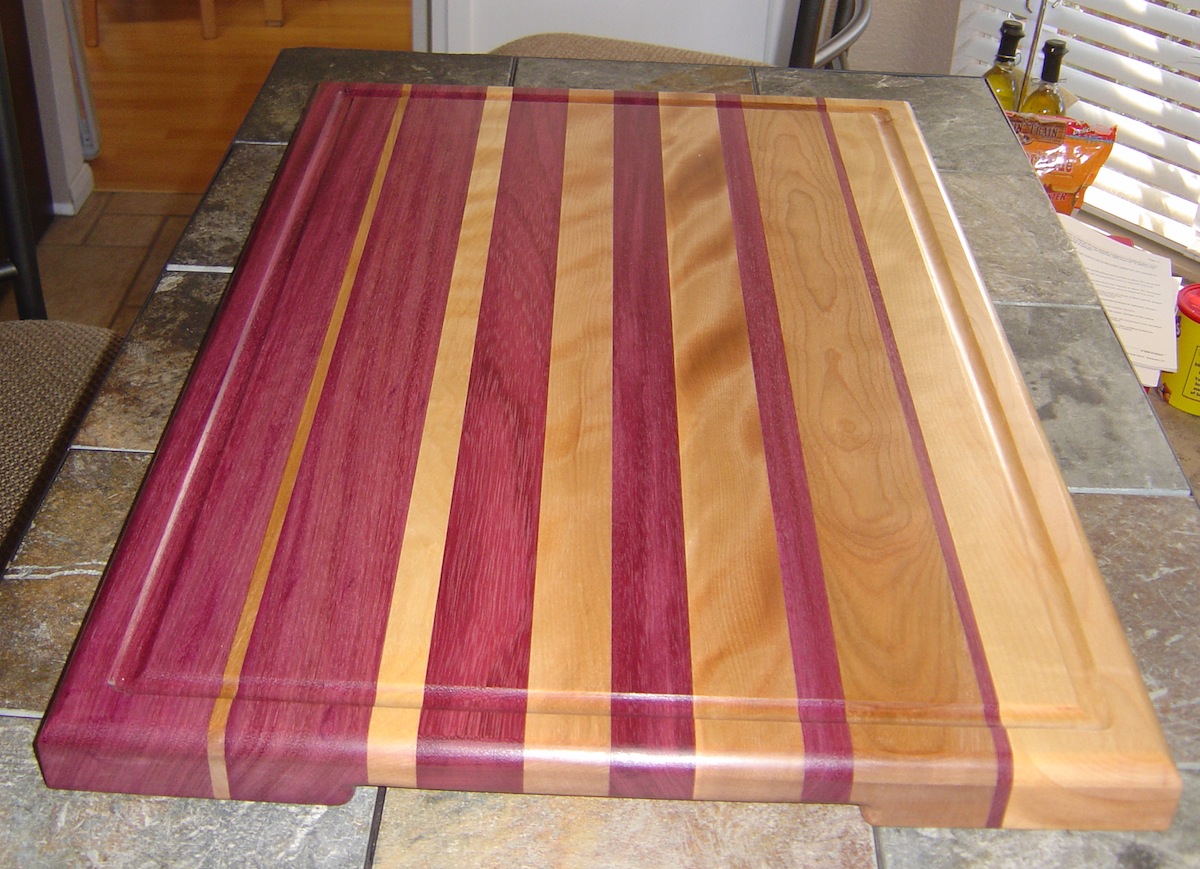
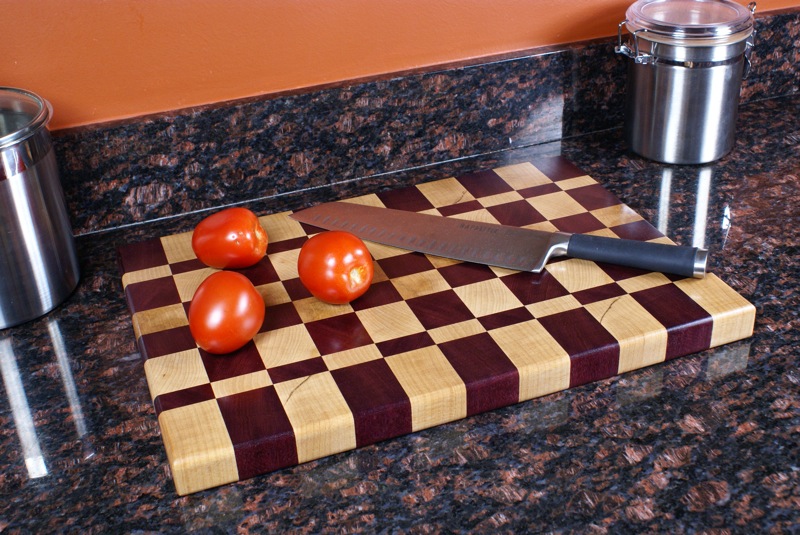
In Part 2 of our cutting board series, I show you two of the most popular ways to finish cutting boards, or any wooden kitchen item for that matter. I also review the care and maintenance required for each finish type.

Want to learn more about my cutting board finish? Check this out!

Having trouble finding materials for this project? Check this out!
Thinking about running your end-grain board through the planer? Read this first!

cuttingboardsmA DVD of this project is available in our store. Purchase your copy today!


Post to Twitter Post to Digg Post to Facebook Post to StumbleUpon

Comments

68 Responses to “7- A Cut Above (Pt. 2)”
  1. Skee says:

    Marc,

    Great episode. I noticed you didn’t mention poly as a choice for the finish. I assume this is because it is completely unsuited for the purpose.

    Nice plug for Matt’s Basement Workshop – I have really enjoyed Matt’s content over the past year.

    Thanks again for all the effort you put into this – they really are fun to watch.

  2. Martin says:

    Marc,

    I enjoyed this episode. Keep up your positive attitude – it makes a difference.

    And thanks for the nice words about Matt’s BW and our LumberJocks.com

  3. Jonny says:

    I just found this podcast from some woodworking forum and went through all the episodes in a few days. Great fun to watch and I really like the cutting boards.

  4. Kiff says:

    Just want to second the “pro-others” approach to your stuff here, Marc. Mention of Matt’s podcast actually turned me on to a resource I’d not yet taken the time to look for, and now am the better for. I’m really starting to digg (hint, hint, everyone) your style and just want to thank you again.

    -kiff

  5. DIGG. haha I get it! :)

    I guess one of these days I should mention Digg and Podcast Alley. Couldn’t hurt right?

  6. CZ says:

    Hey Paul,

    I’m assuming that you treat both sides of the board as well as the edges. Any specific advice on how to do that?

    ~CZ

  7. Johan says:

    Hi Marc,
    I also want to know like CZ if you finish both sides, and also, I don’t have the Salad Bowl varnish. Can you use mineral oil now, and in a month or so refinish with Salad Bowl Varnish?

    Love your site, humor, tips, and I’ll have to find out about digging…

    Cheers

  8. Hey guys. I do indeed treat all surfaces of the board. I didn’t necessarily show that in the video due to time considerations. But all surfaces are treated exactly the same with the same number of varnish coats.
    You can use mineral oil first. Just make sure the finish has plenty of time to cure before applying the varnish. And before applying the new finish, I would give the whole board a nice wipe-down with lacquer thinner or denatured alcohol to remove any surface oil. Once it flashes off, you can apply your salad bowl varnish.

    Good luck!

    Marc

  9. Peter says:

    Marc,

    Wow! Love the site and I am working my way through all of the podcasts while my six week old son is napping…

    A couple of quick questions regarding this cutting board episode:

    1.) I noticed that you cut the board on the table saw with the fence up against the slice you were taking out. I don’t own a table saw yet, but I thought that was a no-no. I also noticed that you had a wood block running the length of your fence. What for?

    2.) You answered someone question about recoating all sides of the board, but I was wondering if you had to wait for the top side to cure/dry befor flipping it over to apply the finish to the underside? Or is there a trick that lets you save a few days…

    I can’t tell you how great I think your podcasts are! Keep up the great work!

    ~Peter

  10. Hey Peter. Well first off, congrats on the mini-woodworker! Getting any sleep lately? :)

    1- I agree that that type of cut is not ideal. But in cases where you need a consistent sized cut, it just makes more sense to do it that way. And with some experience and the right push sticks, that cut is relatively safe. I would not recommend doing that as your first cut on a tablesaw, but once you are comfortable with the machine, you should be in good shape to try it. Just be sure to use a good push stick.

    2- You would need to let the board dry before coating the other side. That is, unless you come up with a system that lets the board breathe while it dries. One way to do this is to take a piece of scrap ply and put a few nails into it. Then you can coat the whole board and lay it with the bottom resting on the nail heads. The nail heads might put a slight blemish in the finished surface, but its nothing that a light sanding wont take care of. And if you use a little finish nail. you shouldnt see anything at all.

    Hope that helps Peter. Good luck with your woodworking!!

  11. Kenneth Poirier says:

    Marc:

    By vocation I am a consultant in Regulatory Toxicology and by avocation a serious woodworker. Your comments about the toxicity of various finishes were right on the money and I wont get into an elaborate discussion here except to say “the dose makes the poison” and when using non-approved (FDA) finishes that holds true. I would have no issue personally using food contact items that have been finished with any type of polymerizing (or cured) finish. However, any woodworker who either gifts, donates or sells these products should consider the potential legal ramifications of using a non-approved finish. For this reason I would strongly encourage that these products be finished with FDA complient products such as mineral oil, Salad Bowl Finish or other natural oils.

  12. Tutu Saad says:

    Dear Marc,

    I am from Bangladesh. Can you give me the basic formulation of Salad Bawl Finish. Can you tell me is mustard ( brown) oil FDA complient for wooden utensils like cutlary, serving plates etc?

    Thanks

  13. Hi Tutu. Most salad bowl finish in the US is just varnish. As for mustard oil, I never even heard of it. From what I can see though it seems to be a kitchen oil. Most oils like canola oil, vegetable oil, and oilive oil will go rancid on a cutting board. So please, do your research on mustard oil before applying it to the board.

  14. Jerry Marshall says:

    Hey Marc,
    I really enjoy your podcasts–they’re lots of fun to watch. Regarding the cutting boards, it’s important to get the first lamination dead level. I don’t have a drum sander, and when I flip the 1 1/4″ strips over on their side and swap ends on every other strip, things get a little gappy. I could throw a cat through some of those gaps. All I know to do is to go back to the table saw and shave each side of the strips. Then, when I line up the strips, they’re gap-free, and we’re good to go on the last glue-up. Love the podcasts–keep “em coming!

  15. Troy says:

    Thanks Marc. I love the design and simplicity. I instantly knew this would be a great holiday gift. I made two, cause initially, I was supposed to make one for my M-i-L, but I let the LOML see it and she took ownership of the first one. So, I made two. My wife said quote “Mom will wet her pants when she she sees this.” Apparently, the other two gifts for the other fair-gendered family members are going to freak when they see it and they don’t get one yet.
    It’s all part of the master plan. They are getting one next year.
    BTW, I am going to need you to come up with another fantastic holiday gift within the next few months please.

    Troy

  16. Mapleman says:

    Great videos … I was just given an unfinished cutting board as a gift and was wondering the best way to finish it … Now I know!

    BTW, a great little extra for this board would be a groove about a 1/4″ inside from the top edge to collect the juices from a juicy roast.

    Thanks again and keep up the great work.

  17. Shane says:

    Very nice. I am still in the middle of the job, bit it is looking really good.
    Have you designed any small trash boxes for the kitchen?
    I’m new to wood working and having a blast!

    ~Shane

  18. Shane says:

    If the finger cut out is only 1/2″ deep, how do you get the 1/8″ roundover bit in without hitting on the bearing bolt of the bit?

    • Hey Shane. I imagine it varies from manufacturer to manufacturer, but I was able to just barely get the bit in there. If you know you want to ease the edge with the 1/8″ bit, its probably best to measure the bit first to make sure you have enough clearance. Or just round over by hand. Its not much area so it would only take a few min. with some sandpaper.

  19. Shane says:

    Disaster!
    I am building 5 of these at a time for christmas.
    They look awesome but it got cold here last night and they warped before I could finish them.
    I ran one of them through my planer very gently and it helped but I am afraid of tearing them up.
    Help.

  20. Shane says:

    Can I wet the board to straighten it?

  21. Tony says:

    Hi Marc,

    Great information on building a cutting board and finishing it.

    I’ve made a small endgrain board that I’m looking to use as a cheese server. Made out of pine with very good patterns. Previously I’ve simply oiled my cutting boards as you describe. I’d like to use the varnish finish but I’m not sure if it will bring out the grain like the oil finish does.

    I’ve also considered just giving it a light oiling and then varnishing it.

    Can you please suggest the best way to go?

    Thanks,
    tony

    • Hey Tony. A few things. In general, most people report that the varnish does a better job of bringing out the beauty of the wood than the oil alone. The oil has a tendency to make the surface look a little dull and lifeless. I am assuming we are talking about mineral oil here. Now I would NOT recommend coating with mineral oil, followed by varnish. Remember that mineral oil never cures. So if you topcoat with varnish, the varnish will have problems curing. So either go oil, or go varnish, but don’t combine them.

      And jut to reiterate, this method is intended for endgrain boards. So if your boards are long grain, you might just want to stick with the oil.

      Hope that helps. Feel free to email me if you need further clarification.

  22. Tony says:

    Hi Marc,

    Thanks for the quick response.

    Yes, I’m talking endgrain boards. From your advice I’ll just varnish this small one and see how it looks.

    I have another (larger) board I did earlier (my first attempt) which I’ve already oiled. I had considered varnishing it for additional protection, but from your comments sounds like I should just leave it oiled, or may be add a coat of beeswax.

    cheers,
    tony

    • Tony says:

      Hi Marc,

      One other thing. Am I correct in assuming you use Satin rather than Gloss varnish? My thinking is that a Satin finish normally hides knife marks better than a Gloss finish.

      thanks,
      tony

      • Actually, I only use gloss on my boards. I guess in my head I am trying to get the “purest” finish possible on there. And since you aren’t building a film, there really shouldn’t be a visible difference between satin and gloss.

  23. Dave says:

    Hi Marc,

    Im kind of new to wooodworking … i had been wanting to try making a cutting board and stumbled over here and love your site. Just have a finishing question (yes, yet another lol! … and no i wont repeat anything asked before). I have read in several places that tung oil in its pure form is non-toxic. When applied properly (several coats) it binds with wood and makes the surface completely waterproof. Is this true ?

    • I must admit that I have never applied enough tung oil to a piece to determine just how water-proof the finish can be. But, I have read the same thing many times. So I would say its certainly worth a shot. The fact that tung oil actually dries, gives it a few bonus points over mineral oil. And as long as the material truly is labeled PURE tung oil, you should be ok. In fact, I think I may try this on a future cutting board.

      • Dave says:

        Ill probably end up trying tung oil too on the cutting board too. Just a note on my past experiences with 100% tung oil. I tried the old masters after reading some review about it … the finish looked great but it had some voc associated with it, which it shouldnt if it was pure. I tried woodcraft tung oil it seems like its just pure oil. You still need to thin it to apply it well but, atleast you know what you are putting in it.

  24. Scott says:

    Marc,

    Curious if you wipe off the excess finish after each coat. That is, you put it on for 3-4 minutes, then wait a minute or two, then wipe down the board. It seems like you simply apply the finish and let it dry, but that would also seem to build up a film.

    Great website!

    Scott

  25. william says:

    hey Marc im just starting out playing with wood and since i cant find any part time schools for this im going to try to learn everything off of your shows. im going to start with those awesome end grain cutting boards and ill do a couple of them to get a good hang of it, then ill give them out to friends. but i need a little advice. what other type of wood combination can i use on a cutting board? id like to be diverse and creative with the colors and patterns. so if you have any suggestions also on different cutting patterns that would be cool too. i was thinking of using walnut, and cherry wood just off the top of my head, but i dont know if theyr are tight grain and hard. thanks so much Marc appreciate all your hard work im learning so much.
    -wil

    • thewoodwhisperer says:

      Hey William. I am glad to hear you are getting into woodworking. Its pretty addictive so watch out. :) And be sure to take advantage of all the great resources we have available to us on the web. My site offers just one perspective, and there are many approaches to the craft.

      Now on to your question. When it comes to cutting board, most times its better to play it safe. While I’ve seen lots of different woods used in cutting boards (including exotics), I usually try to keep it as simple as possible. I’ve been using purpleheart for a while now and feel its just as safe as maple. But many other exotics have a good amount of natural oil in them. Personally, I am concerned about what else might be in that oil. So if the wood is oily I don’t use it. Now it is also a good idea to avoid open pored woods like oak, ash and possibly even walnut. But I have seen hundreds of boards using walnut……

      Bottom line is its a gray area. There isn’t a whole lot of info out there so that’s why I like to play it safe. If you are looking to try a colorful wood, do a bunch of research to determine if there is some allergy or toxicity concern. And of course it best to just avoid the odd ball exotics. And as tempting as it is to use this system to make fancy colorful patterns, it might not make the best material for a surface that will be in contact with food.

  26. Willie says:

    Hi Marc,
    Was wondering when you thin the salad bowl finish with mineral spirits…(this may sound stupid) but are you talking the kind you pick up at the local building center? Great site!

  27. patrick melchior says:

    Marc,

    I am new to wood working and must say that I enjoy your website. I DID in fact make the cutting board, but the question I have is the finish. I have applied 4 or 5 coats of mineral oil and have wiped it all down. I was so proud of the cutting board, it actually looked like the one you made in your pod cast. In fact, once I put the cutting board in the kitchen, my wife wasted no time in putting it to use, I about had a heart attack…I didn’t want her to use it… just look at it in all its beauty. I got over it quick as she sliced through the tomatoes…anyway, after she hand washed the board and let it dry, the surface was rough. I sanded the board up to 320 grit ( smooth like glass) when I made it. Did the water when she washed it raise the end grain? I would think thats normal but was not prepared for the feel of the board after.

    Thank You

    Patrick Melchior

    • thewoodwhisperer says:

      The first cut is always the worst one Patrick! lol. But an unused board never reaches its true potential. I am glad to hear she wasn’t afraid to dive right in and start cutting!

      In general, the board will go through a lot of surface changes in the first few months. As the board goes from wet to dry to wet to dry…….the grain gets raised and the glue lines become more evident. So usually I wait about 6 months, then I take it back into the shop for a light sanding and refinish. This 6-month wear-in period almost has the same affect as pre-raising the grain before finishing. So that once you clean up this second time, it will stay smoother and the glue lines will be less likely to show up. Now the fact that you are using mineral oil does muddy things up a bit, literally. When you take it back to the shop, you’ll find that your sandpaper gums up pretty quickly. Just do the best you can to sand the surface smooth up to 320. And you don’t necessarily need to get down to bare wood.

      Now since mineral oil still does allow moisture to absorb into the board, you will be more likely to have the roughness return than if you used the varnishing method. But as hard as it is to remind yourself, it is just a cutting surface so a little roughness is to be expected.

      I also would try to avoid adding mineral oil a month or so before bringing it back in the shop. You want the board as “dry” as possible.

      Hope that helps.

      • patrick melchior says:

        Thanks for the info Marc. no that the soap box is open I would (wood) lol, like to give you some feedback. I, as well as all the wood workers who follow your website appreciate the fact that you are independent in your opinions, and not a shirt and tie guy, a corporate man. I feel we relate better to you and your opinions. I hope you remain true to your core foundations that got you to where you are today. I understand that you have to make a living, ROCK on!!

        keep up the great work… you and your wife are both hard workers and your funny

        thanks again

        patrick melchior

  28. jdog says:

    what is that adapter you use to attach that router to you dust collection? Is it just a hose with hose clamps on it or something? I need to get an adapter to reduce my 2 1/2 hose down to 1 1/4. Anyone got any ideas? i cant find an adapter.
    thanks

    • thewoodwhisperer says:

      Yeah that was actually just a hose coupling off the shelf from Home Depot. If I remember correctly it came with the clamps attached and was in the irrigation area.

  29. Frank says:

    Marc,

    I am batching out a bunch of these and variations of them for Christmas presents for different family members. Have you ever heard of a problem with these things as far as wood movement? I don’t want to have to hear everybody complain in a couple of years, although I’m not letting the fear of that stop me from making them now.

    • thewoodwhisperer says:

      While there could be an occasional “disaster board”, I have yet to experience one myself. And given the number of boards i see being made, I think we would all hear about it if they started moving. So just from my observations, the boards are pretty darn stable. Batch away!

  30. Dan says:

    Hi Marc,

    This is my first post, though I’ve been watching your videos for some time and would like offer you immense thanks for your teachings. I’m in the process of building my first end-grain cuttings boards and need to decide on the finish. My problem is I like the low-maintenance of the salad-bowl finish but the look of the mineral oil. Is there any practicality in one flooding of mineral oil, then drying, then one or two coats of salad-bowl varnish? As of now, I have neither of these products so I am unable to experiment. Any advice you can offer is appreciated, and thank you again for your work.

    Dan

    • thewoodwhisperer says:

      Thanks Dan! By adding salad bowl finish at all, you are going to change the look of the cutting board. And every application of the salad bowl finish gets you further away from that mineral oil look. And once you’ve treated the board with the varnish, you negate the need for mineral oil.

      Now I wouldn’t recommend putting the mineral oil on first, simply because mineral oil never dries or cures. It soaks into the wood and eventually wear off the board. But mineral oiled wood always seems to have an oily feel to it and that’s exactly why I don’t like it. So if you were going to try some sort of “hybrid” approach here, I would recommend doing the reverse. I would give the board 1-2 coats of diluted varnish. Set the board on end each time to let it dry and to capture the varnish inside the grain. After two coats, sand the board down nice and smooth. At this point, the wood will probably still take up a very small amount of liquid, but it will be mostly sealed. At that point, apply a very light coat of mineral oil and see what it looks like. Depending on how sealed the wood is, the oil might simply absorb and give you that mineral oil look, or it could just sit on the surface and remain “wet” until it just wears off. I haven’t tried this so I don’t really know.

      Now I do occasionally add mineral oil to my varnished boards if they get all scratched up. The oil makes the scratches a little less visible and extends the time between refinishing. But ultimately, the whole point of using varnish in the board is to avoid maintenance. And applying mineral oil is part of that maintenance that I am trying to avoid. Not sure I’ve helped you here, but that’s my experience so far.

  31. taylor fitzgerald says:

    hey this video was great, i’ve made 2 of these beautiful cutting boards, using rock maple and other hard woods, the pattern you chose looks really great, send more vids!

  32. Justin Hicks says:

    Hey Marc,

    Love the videos and content. I’m make a few of these boards as gifts. I have one question about the finishing process. Before the final coat of finish you lightly sand with 400 grit paper. When I did this and applied the last coat of finsh the sanding lines were visible as there is no “gain” to hide them, and I tried to sand as lightly as possible and only took a few strokes just enough to make the surface smooth.

    Any sanding tricks you can share? Or do you just live with the sanding lines. They really are only obvious when viewed in raking light.

    Justin

    • thewoodwhisperer says:

      Well, you could try sanding with 600 grit, so that you make finer scratches. But if your final coat isn’t covering up 400 grit scratches, that tells us you might need to have a bit more varnish in the mix (if there were a piece of furniture). But you want to be careful not to add too much of a film to a cutting board. We aren’t really looking to create a glossy board. And if there is a gloss, it should wear off and become dull rather quickly. So I might even recommend giving the board a few days to cure up, and buffing the surface with 0000 steel wool. That should help give you an even dull scratch pattern.

  33. Dean Peddle says:

    I have a question about the finish. I followed your instructions using the salad bowl finish and thinning out with Varsol (mineral spirits) but isn’t mineral spirits poison? Aren’t we taking a non-toxic finish and making it toxic by adding poison? I made 6 of these and gave them away as x-mas gifts (we celebrate early) and one comment was the board stinks….which it does. I don’t know whether it’s the salad bowl finish that stinks or the varsol that I used to thin it with. It’s cured for over 72 hrs. Is it safe to use?

    Also, when you finish…you thin the first coat but you didn’t mention the other 2 coats…I assumed they were all thinned with mineral spirits….correct ?

    • thewoodwhisperer says:

      Hey Dean. The key is to look at the ingredient list and MSDS for your salad bowl finish. One of the ingredients will be either naptha or mineral spirits. So salad bowl finish is toxic. The important thing to not is that they are non-toxic when cured. So I always give my boards a few weeks to air dry before actually using them. All oil-based finishes will have an odor for quite some time. So after 2-3 weeks, the odor is minimal and I just tell the recipient to give it another week before using it. Then before the first use, give it a good washing in warm soapy water. From that point they are good to go.

      As for the dilution, I do continue to use the diluted solution for each coat.

  34. Dean Jackson says:

    (Thanks for the great videos!)

    Everything on this one looks pretty good, and I made a rock maple and hickory board. Sanded it up to 220, completely smooth. Put Watco Butcher block finish thinned with mineral spirits on this today, and some of the maple has a white splotchy-ish color on it. (http://www.flickr.com/photos/talldean/4310138174)

    Will a second coat help? Did I not sand enough? Would more sanding at this point help, or just ruin things?

    • thewoodwhisperer says:

      You know, that almost looks like glue stains. Sometimes when you have excess glue, is seeps into the grain and partially seals it. So when you coat with your finish, you see a spot that just doesn’t absorb as much oil and as a result its lighter in color. Hard to tell for sure, but that’s my first guess. But if you sanded the surface thoroughly, its hard to imagine that being the case. Could just be something weird in the wood itself and you could sand forever and never get rid of it. Bottom line is, there shouldn’t be much of a film finish on the board anyway, so it might be best to finish the thing up and get it into use. The spots dont look all that bad to me.

  35. Dane says:

    Hi Marc

    I have made 3 boards of maple and purpleheart and have been very pleased. I have enough sapele for several boards and was wondering if it would be appropriate to use for a cutting board. I would use maple as the other stock? Love your videos! Thanks in advance.

    Dane

    • thewoodwhisperer says:

      Hey Dane. I don’t see any major problems with sapele for an end grain board. But just as a disclaimer, I can’t know for sure what the potential is for allergies/toxicity with these exotics. So do as much research as you can and always use exotics at your own risk. But from my vantage point, I think sapele would be fine.

  36. William Parker says:

    Hello MaRC
    The cutting board was a great piece of work. My question is about using other types of exotic hard woods to make difference color cutting boares. I know some exotics are toxic, do you know were I can find a listing of which woods are toxic and should not be used for this application.

    WSP
    White Plains NY

    • thewoodwhisperer says:

      Hey William. This is always going to be a subjective call by each individual. Most times, the toxicity comes when dealing with dust getting into your lungs, eyes, or blood stream. In a cutting board, there is little if any ingestion of the actual wood product. But I am also a little leery about the oils secreted by some of these exotics. So in general, I try to avoid them. Purpleheart doesn’t have much in the way of oil, and seems like a decent wood for a cutting board. But that’s the only exotic I have ever included in my boards. And I don’t make any claims that it is completely harmless. But based on the info I have access to, I don’t feel I have anything to be concerned about when using Purpleheart for a cutting board. Here is a wood toxicity chart that may help you make your decision. http://www.woodworkerssource.com/toxicity_list.php

  37. Dean J says:

    I feel bad asking so many questions on the simple project, but this has really been a learning experience all around in making a few different boards.

    So, I have some butcher block finish from Watco. It explicitly says “do not thin”. Any idea what that means to me?

    • thewoodwhisperer says:

      Hey Dean. Many cans of finish will say that. Its just their way of making sure you don’t add more VOC’s to the mixture. As long as you use the right thinner (paint thinner, mineral spirits, naptha, etc), you can thin all day long.

      • Dean J says:

        What’s the “wrong thinner” in this case? I’ve just been using odorless mineral spirits, and those seem to work just fine. Any advantage to any of them? Any less toxic or faster drying?

        • thewoodwhisperer says:

          You are using the right stuff. Ethanol and lacquer thinner, for instance, would be the wrong stuff. Naptha is a little faster drying if that’s what you’re looking for. But its usually more expensive too.

  38. Dave Morrison says:

    Hi Marc,

    I am going to make this cutting board and I saw another plan for similar type board and it had rubber bumpers screwed to the bottom. Do you think your cutting board needs them so the cutting board won’t slide around on the counter when trying to cut something? Also, I was thinking of adding a 1/4 inch maybe 3/16 inch deep rabbit on top to collect any juices from my stakes that I plan to cook and cut on the cutting board? Any comments would be appreciated. Thank you…..

    • thewoodwhisperer says:

      Hey Dave. There is nothing wrong with adding the rubber feet if you want. I never really feel the need to do that and I don’t have a problem with my boards sliding around. If the board winds up warping on you, you could very well add them to help keep the board stable.

      And although I don’t always put a drip edge on mine, they are a great feature to have on a cutting board. Although I would highly recommend using a core-box bit for this, and not a straight bit. Its much easier to clean the juices out of a shallow groove with a rounded bottom.

      Good luck!

  39. student says:

    hello marc.
    i m an accountant by profession but woodwork attracts me alot. i m from pakistan and i want to learn this art. This site is nothing less than a treasure to me. i m trying to collect tools right now. i hope u’ll b a great help in future too. This video/artwork is truly amazing. i wonder how easy it seems when u play with wood. Here in my country i’ve never seen someone so confident with the project. keep doing the good job.

    Regards,

    A student.

  40. Simon says:

    Hi marc,

    I have a question about the finishes you are describing. Am I misunderstanding, or are you refering to “wiping varnish” and “salad bowl finish” as the same thing?

    I have tried to source them locally, but I am wondering if the common name is different in Canada. Lee Valley tells me they have items under both names, but that they are diffeent items. And, neither is quite what you seem to be describing. The guy I spoke to told me that he would not recomend what they sell as wiping varnish for a cutting board.

    And, what they sell as salad bowl finish looks like it is simply a pre-mixed blend of mineral oil and bees wax. So, it might work for me, but it doesn’t sound like what you are describing.

    Any ideas?

    • thewoodwhisperer says:

      Hey Simon. Salad bowl finish, unfortunately, is a very generic name. It could mean anything. So you have to actually look at the ingredients to figure out what’s in it. The salad bowl finish I used on the show is indeed the same thing that is in a can of “wiping varnish”.

      To address the question of whether you should use a varnish on an end grain cutting board, check out this post where I explain my viewpoint thoroughly: http://thewoodwhisperer.com/cutting-board-finish/

      In summary, varnish applied to a end grain board, in the method I describe in this video, provides a great finish for a cutting board. If you are making a long grain board or if you just don’t like the idea of using the varnish, then the mineral oil and beeswax would be a fantastic option.

  41. Mel says:

    Hi Marc,

    I greatly appreciate the details in your webcasts, allowing for a variety of options and applications — awesome job!

    I would very much like to create an end-grain counter-top (approx. 6′ x 24″) for a bar-counter, as well as a matching island top for a small 24″-square rolling cabinet in my kitchen. I’d like to use varying shades of lyptus to create a subtle pattern. I am theoretically new to woodworking, though I once made an edge-grain butcher block of maple and cherry in woodshop (27 years ago) that my mother uses today — so I guess it held up alright.

    Clearly, I would start with the small island top, before tackling the larger unit. Do you have any specific tips for extrapolating to other dimensions, and for working with and maintaining a piece that large? Also, is there a suggested thickness for a typical counter-top?

    Thanks for any advice!

    • thewoodwhisperer says:

      Hey Mel. If you are looking to design a larger end grain surface, I would take the time to load up this program: http://www.lastalias.com/cbdesigner/

      Thinking through the multi-step process to decide on the relative size of parts and their position in the final design. So this program should be able to help. I haven’t used it myself.

      As for the counter thickness, I’d say anything from 1 1/2″ to 2.5″will work. The whole thing should be supported so you don’t have to worry too much about it being too thin.

      Now I do want to say that I have never made an end grain design on such a large scale. I get questions about it all the time so I know people have had success with it. But depending on how you orient the grain, you can have stability issues. Plus there are so many glue joints that the opportunity for problems is significantly multiplied. Just be sure to take some time to organize that grain properly so you stack the cards in your favor.

Speak Your Mind and Win a Prize!

Leave a comment and you could be a winner in our Wood Whisperer Giveaway!

  • In the Shop LIVE!

  • Browse By Category

  • Archives by Month

  • Proud To Be Sponsored By!


  • Support our Advertisers


  • What Marc’s Reading:

  • Community Stuff


    Loading the LumberJocks Widget