7- A Cut Above (Pt. 1)

December 22, 2006 by thewoodwhisperer
Filed under: All Videos, Projects 

Low Resolution Version
High Resolution Version
Purchase the DVD


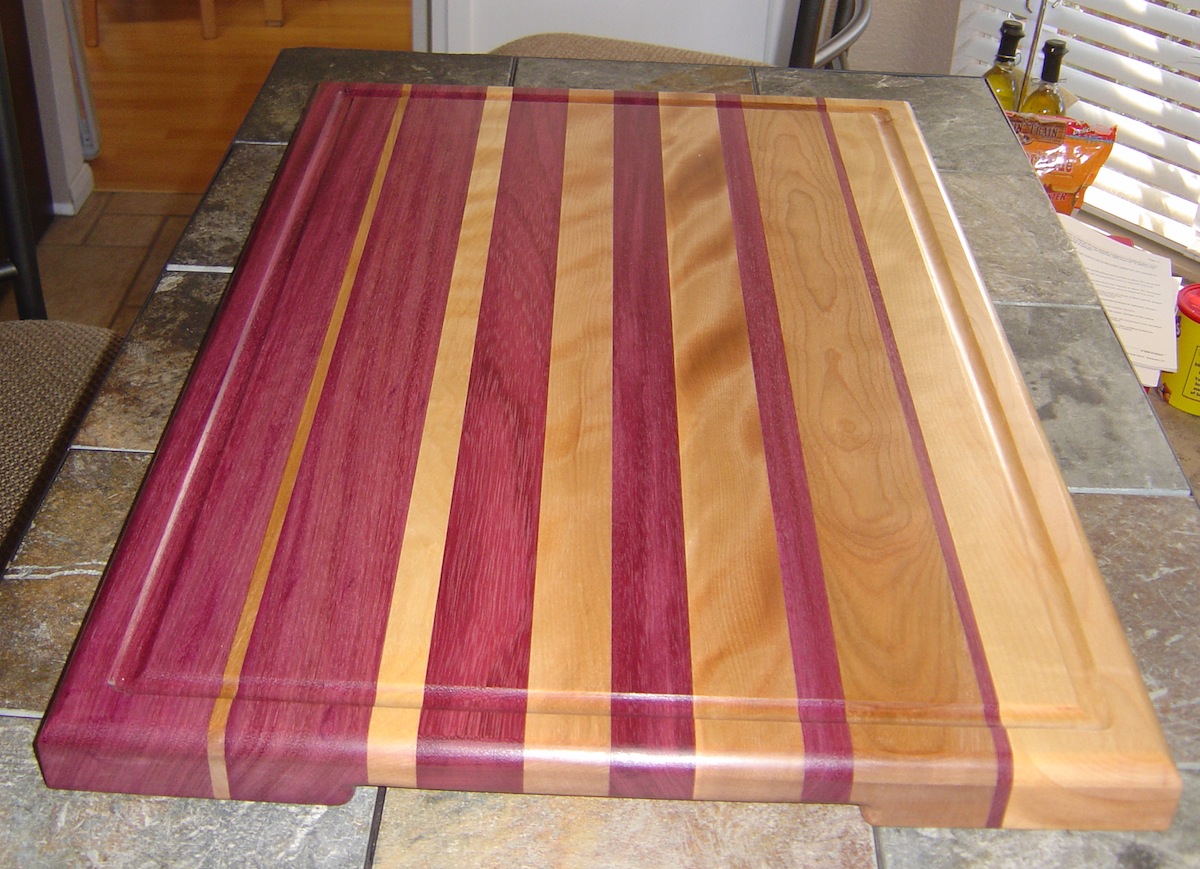
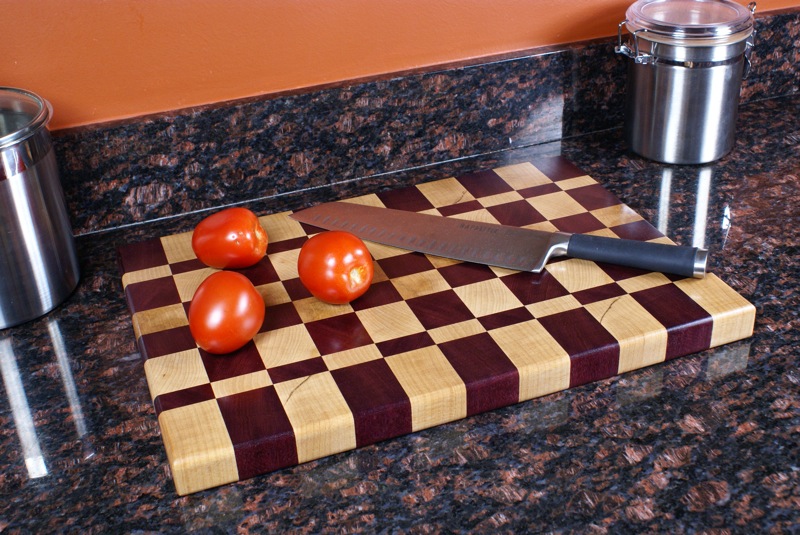
One of my favorite woodworking projects is a butcher block end-grain cutting board. Im not sure if its the “back to basics” simplicity or just the fact that it is one of the most useful projects a woodworker can make, but something keeps bringing me back for more. A custom cutting board makes a great gift and many woodworkers make them in batches every Holiday Season. And if you are relatively new to woodworking, this is a great project to hone your milling, glue-up and tablesaw skills. In Part 1 of this two part series, we cover the preparation and construction of the board itself. I hope you enjoy this project as much as I do.

Want to learn more about my cutting board finish? Check this out!

***New Plan!!*** We finally have a plan available for the cutting board. The plan was made by my good friend (and a heck of a woodworker), Ron Jones. You can download the plan as a pdf here: Cutting Board Plan.

Having trouble finding materials for this project? Check this out!
Thinking about running your end-grain board through the planer? Read this first!

Go to Part 2 of the cutting board series.

cuttingboardsmA DVD of this project is available in our store. Purchase your copy today!


Post to Twitter Post to Digg Post to Facebook Post to StumbleUpon

Comments

64 Responses to “7- A Cut Above (Pt. 1)”
  1. Stan says:

    Nice podcast. Too bad they aren’t a bit longer.

    Speaking of planes, I’d like to see a future show on planes: sharpening and using them to create flat surfaces on something large like a tabletop.

  2. Doug Hicks says:

    Did anybody but me notice that at the end of Marc’s latest show (A Cut Above, Part I) that TheWoodWhisperer.com was misspelled as TheWoodWhsiperer.com and the same mistake was on the e-mail address. Now, if I know Marc, he will blame this on the Missus. I enjoyed the show anyway!

  3. tom says:

    minor spelling error on your last podcast about the cutting board.
    The wood whsiperer is shown on the email address
    good episode cant wait for the next!

  4. The Wood Whisperer says:

    Well, that was actually a test to see who was paying attention. You guys win!! :)

    Marc

  5. Richard says:

    I subscribe to your podcast through iTunes and enjoy them. But …

    The cut you made today on the glued up layers of the cutting board is very dangerous. In every table saw book of safety procedures the tell you never to do this.

    ‘Never cut cross grain against the fence.’ (Try that on Google and see how many hits you get.)

    Having said that, I done it a number of times. I always realize that it is not a safe cut and I brace myself and use a good push stick. The push stick you were using could only be described as ‘weenie’.

    I’ve placed a crude picture here. ( http://www.americankestrel.com/images/pushstick.jpg ) I make a couple of these a year and usually embed a magnet in the side to that it is easily attached to the table saw. It is usually made out of plywood and I’ve seen guys that make the sacrificial notch so that it is replaceable.

    I can cut one out on the bandsaw in under a minute so I don’t go to that kind of trouble. Drilling and placing the magnet takes a little longer.

    Like you and ‘Norm’ I don’t use a blade guard although if I was making a video I would that was because it is easier for the camera to see the cut. I have a splitter on one table saw and think it is a good idea for ‘rough’ or green wood.

    Thanks for the show.

  6. The Wood Whisperer says:

    Hey Richard. I am flattered by your concern for my safety. ;)

    I will address a few of your points though. The general rule about cross-cutting end-grain against the fence stems primarily from the fact that most lumber is much longer than it is wide. So cross-cutting a 6″ wide board that is 36″ long is very dangerous against the fence. In general, you never want to cross-cut anything that is longer than it is wide. But when your end-grain surface is sufficiently wide enough to support the piece through the entire cut,  the cut is permissible (at least in my shop). The cut is definitely on the more “challenging” side, but I honestly don’t think its all that dangerous with the proper precautions.

    Now I have to defend my weenie push stick. lol. As far as Im concerned, the push stick that gives you the best control over the cut is the best push stick for the job. I actually have several push sticks like yours and I used them on the first few cuts. But I really wasnt happy with the quality of the cut and to make matters worse, the stick would get jammed between my anti-kickback prawls and the fence which is obviously no good. So I opted for my trusty skinny push stick, which yielded a cleaner cut and easily passed between the fence and the splitter. But for many people, a forward-pressure push-stick like yours might be the best option.

    And finally, a few words about the splitter/blade guard. I actually DO have a blade guard AND a splitter.  And unlike Norm, I dont remove my blade guard and splitter “for clarity”, as I have hear Norm say.  My blade guard was pushed out of the way so that I could make the cut safely. There are many cuts where a blade guard actually makes things more difficult and more dangerous. From your last few comments, it actually sounds like you favor a blade guard over a splitter (forgive me if I misunderstood). But do yourself a favor and make sure you have a splitter on your tablesaw whenever possible. The blade guard is a nice feature, but it won’t do a darn thing to protect you against the most dangerous and common tablesaw mishap, Kickback.

    It makes me feel good that you are safety conscious. Like I said in my videos, I will always do what I feel is the safest method for me. But if you know of a safer method, by all means use it, and be sure to post it here for everyone’s benefit.

    Thanks Richard. Have a good New Year!

    Marc

  7. Charles says:

    Great video again.

    Always entertaining. Keep them coming as there are plenty of us that need to see something to know what is going on.

  8. John Rezz says:

    Marc,

    I found a huge piece of purpleheart at woodcraft in Loveland CO. for less per board foot than oak…. in other words my cheap ass bought it. I decided to make one of your cutting boards since I have a huge stockpile of maple at the house….

    So you perform a sneaky little trick in your podcast :) You changed from one glue up pattern to another after you make your 1 1/4 cross cuts, no big deal I just could not figure out what was differetn beteween mine and yours. I will make the next one with the 3/4 cuts inside…

    Thanks for the project… I have made several cutting boards in the past but I really like the contrast between the purpleheart and the maple….

    Keep up the good work and I hope to see you on TV soon…

    John

  9. Karl B says:

    My wife and I love your Cutting Board Vid, especially the “….cuttinnnnnnnnng boarrrrrrd” part. The phrase is repeated many times a week around our house.

    Thanks for the awsome episode and keep up that sense of humor.

    KB

  10. Jonathan says:

    Marc, I just ordered the wood so I can get cracking on a couple of these cutting boards. I’ve only just bought a table saw so I think that this will be a great second project (the first was a birdhouse. :-) )

    Thanks for putting this podcast together. I’ve watched this particular episode many times dreaming about the day I’ll FINALLY get the stuff together to give it a try.

    Jonathan

  11. Jerry Marshall says:

    I’ve tried to level the surface of the first glue-up by sanding it with 80 grit on my random orbit sander and my belt sander. Bad idea. It looks good, but when I cut the board into 1 1/4″ strips and alternate them for the second glue up, things tend to get a little gappy between the strips. to the point that I could throw a cat through some of the gaps. So I go back to the table saw and shave the strips on bothe sides to achieve a perfect fit. After I do this, everything lines up dead on. I suppose I could avoid all of this by using my planer, but it seems awfully abusive to the machine and makes a heck of a racket. It scorches the wood too
    Love the Podcasts–they’re lots of fun. Keep “em coming!

  12. Steve says:

    Marc — A friend of mine tells me that he thinks plastic cutting boards are less likely to harbor microbes than wood. I’ve read dozens of articles that address this issue but have found nothing definitive. I KNOW that you have an opinion about this… and I think I can guess what you will say. Anyone who is concerned about milk carton safety definitely has an opinion on cutting boards. A reply from a microbiologist will definitely help settle the argument. Thanks!

  13. Well Steve. If you do a little digging you will find numerous articles with conflicting claims. Some say plastic is more sanitary and some say wood is. The claim for wood is that it has a natural anti-microbial properties not found in plastic.
    So what do I believe? I believe that bacteria will grow on anything that is not kept clean or properly cared for. I sanitize my boards with a little white vinegar and some folks like to rub salt on the surface. And I never cut meat on my boards. I know it sounds crazy, but I reserve my fine boards for vegetables only. The meat is cut on plastic. And the primary reason is because I can spray that sucker with bleach and throw it in the dishwasher if I want to. Thats the safest bet as far as Im concerned.
    Unfortunately I have never done any testing and Im not sure what to believe from the conflicting studies I’ve read. So the best bet is to have safe practices and good habits.

  14. Kent Follmer says:

    I am sorry Marc, there is just something NOT right about the Wood Whisperer cutting anything on plastic. I can understand keeping one a really nice board from being damaged by heavy use in order to keep it looking new, but can’t you find an old (wood) end grain board to cut on? I have read enough on the plastic v. wood debate to conclude, Wood Wins. Wood always wins. I am sure you can figure out a way to clean a wood board after cutting meat. Don’t you think so WW?

    Kent Follmer
    Champaign IL

  15. Kent Follmer says:

    I apologize Marc for my previous post above. After reading it again, I see now it may have been inappropriate. I enjoyed watching you throw the plastic board over your shoulder in your video and I was surprised to hear that you use one for meat.

    Here is an article written by an unbiased Phd that did an in deptch study on the subject.

    http://www.alladd.com/cutting_board_study.htm

    This article concludes as follows:

    In addition to our laboratory research on this subject, we learned after arriving in California in June of 1995 that a case-control study of sporadic salmonellosis had been done in this region and included cutting boards among many risk factors assessed (Kass, P.H., et al., Disease determinants of sporadic salmonellosis in four northern California counties: a case control study of older children and adults. Ann. Epidemiol. 2:683-696, 1992.). The project had been conducted before our work began. It revealed that those using wooden cutting boards in their home kitchens were less than half as likely as average to contract salmonellosis (odds ratio 0.42, 95% confidence interval 0.22-0.81), those using synthetic (plastic or glass) cutting boards were about twice as likely as average to contract salmonellosis (O.R. 1.99, C.I. 1.03-3.85); and the effect of cleaning the board regularly after preparing meat on it was not statistically significant (O.R. 1.20, C.I. 0.54-2.68). We know of no similar research that has been done anywhere, so we regard it as the best epidemiological evidence available to date that wooden cutting boards are not a hazard to human health, but plastic cutting boards may be

  16. Kent Follmer says:

    a knowledgable work worker recently wrote in a post:

    After the legislators declared wood cutting boards unsafe, and required all commercial joints to switch to plastic cutting boards, a University did a study of bacteria on used cutting boards. The found the plastic boards were very unsafe… that the tiny scratches left by the knives were a great incubator for bacteria. The old fashioned wood cutting boards were practically germ free. When I read the study they had not (yet) proved their theory that the moist wood expanded to squeeze the moisture out of the scratches, then dried, killing the bacteria. Whatever the mechanism, the wooden boards were safe, and the plastic boards not only dulled the knives (making them dangerous) but they contaminated the food.

    I no longer use my plastic cutting board. I enjoy my wood prep counter and my wooden cutting boards (occasionally treated with mineral oil, or previously with vegetable oil).

  17. Martin King says:

    Marc,
    The layout of the strips in your initial glue up does not
    jibe with the results shown during the second glue up.
    I had to go back and look carefully at what was really
    going on, you sly devil.
    Cheers,

    Martin

  18. Yea I actually made several variations of the board that week just for the heck of it. Good thing the board looks ok either way. ;)

  19. Cliff says:

    I have tried to make your end grain cutting board but I do not have a table saw, and cutting the boards by hand has proved to be tricky. I instead made some I guess you would say long grain cutting boards, but I have a hard time getting them level…as I do not have a planner what would you suggest I do. Thanks for the time.

  20. Hey Cliff. To flatten a big board like that, either use a bench plane, or you can try the router sled method. The concept is depicted here: http://www.woodworking.org/InfoExchange/viewtopic.php?t=8904

    And all you need is a router and some wood to do it.

  21. anthony says:

    Hello, I just found your site. I am new to woodworking within the past year, and have decided that since I do not have access to a lot of formal instruction, I will concentrate mostly on hand tools.

    I just wanted to say that I have watched a lot of online videos over the past 6 months and yours is one of the most well done and informative that I have seen. I realize it is a simple project, but for a beginner it was quite clear. It was also great that you pointed out that hand sanding would work for the breadboard. and to top it all off, unlike a lot of other videos that give instructions using material that is impossible to locate, you link to a source for materials. Perfect! Thanks for the great video. I have seen these cutting boards on sale for over $100. After I make one for my wife, who knows maybe I can sell a few. Thanks again!!

  22. Adam says:

    Hi. I just stumbled across part 1 of your Cutting Board project, a few days ago. Then I decided to check out your site. WOW!!!

    I just wanted to say THANKS!! As a newbee, it’s great to have a resource like this available. It seems that woodworking is an art that’s generally handed down or pretty much learned by others. It’s hard for a new-comer to figure out the best techniques or even how to use certain tools. And as woodworking is not an inexpensive hobby, it’s hard to know what tools to invest in first, (I still don’t know what kind of table or miter saw to buy) and the salesmen will tell/sell you ANYTHING. I’m sure that this site will provide me with lots of ideas and info.

    I’m also really impressed by the video. Not only is it a great project, the instructions seem really easy to follow. I’m sure mine will turn out great. That is, once I buy some tools. Oh… and once I find the second part. :-)

    Keep up the good work!

  23. John Hammett says:

    Marc,
    I finially got around to making the cutting board and the instuctions were perfect. However, you need to really punch on the thickest after the first cutting. I watch the video three times to find out that the glued board should be 1 5/8″. Other then that, I haven’t had a problem yet. The finial glue up is drying now. I’ll tell you more after I finish it up.
    Thanks, I really have learned a lot with your help…
    John Hammett
    Baker City, OR.

  24. Mitch Howard says:

    Hello Marc,

    Your podcasts are thoroughly entertaining and informative. I was wondering if you have useful tips for creating a marquetry type inlay in tabletops etc. I am making a series of pieces for my each of my siblings and parents, and wish to inlay the a signature design…something to remember me by. I have a rather nasty blood cancer that carries with it a rather daunting survival curve, so I’d like to get started soon.

    I’m no stranger to the shop, but have never tried my hand at inlay before. The intro to your podcast features what looks like a small table with a leaf and stem design, it is a simpler version of this type of inlay I’d like to try.

    Love your work, keep it up!

    mh

  25. S. Baum says:

    I can’t wait to try my hand at crafting one of these puppies! This looks like a project even a cave man could do.

    I’m a professional cello player by trade. So I’m partial to hand tools for a couple of reasons: 1. They were good enough for Stradivari; and 2. I’m more likely to keep all my fingers.

    Which brings me to my question. What’s the “hand tool” of the 17th/18th centuries that I would need in lieu of a table saw? A hand saw doesn’t seem like it would cut it, so to speak. Or would it, with enough practice?

    • thewoodwhisperer says:

      A hand saw would indeed be the tool of choice. Makes ya really respect what our forefathers were able to accomplish doesn’t it?

      • S. Baum says:

        Marc. Not that I doubt the master. But we’re brainstorming here, right? Jerry’s reference above to cats and gaps continues to cause me pause… What about a hand miter saw? I confess I don’t have a clue what it does, but from the looks of it, a straight, accurate cut seems more likely than “freehanding” with a hand saw. Is the cutting board too big for it? If so, do you suppose one could jury-rig a suitable facsimile? Failing all that, can a body rent time on a table saw somewehere? :-)

        • thewoodwhisperer says:

          A miter box would certainly give you a more controlled cut. But it is really intended for cross-cuts. For this project, you will still need to do a lot of ripping, which would exceed the capacity of any miter box. I would imagine to do this all with hand tools, you are going to need to do your best to cut to a line, then clean everything up with some hand planes.

          And the easiest answer is to make a few friends. Never hurts to have a buddy with a tablesaw! lol

  26. Jeff says:

    Hey there Whisperer,

    I found this website by googling for directions on building an end grain cutting board. I’ve never worked with wood other than framing decks and houses, but this project looks fun and easy enough to take on. Thanks for the video, I know they take a lot more work than people realize. Great job.

  27. Tommy_Joe says:

    Great Video! I need to get the podcast for that also.

    I have the same push stick and really like it. ;-)

    Two questions… You have a link to Bell Forest Products for the material, which is great. Are there other domestic wood that you would recommend? I know Oak is out, but could Cherry or Walnut work? The other question is the cutting board itself. If I made one exactly like it or similar, and sold a few (you know… to make money for more tools), will I get in trouble with you or your lawyers?

    Thank you for sharing your talents!

    Tom

    • thewoodwhisperer says:

      Hey Tommy_Joe. I have seen boards made of just about every wood you can imagine. Cherry, walnut, and even oak are common. If I could do the video over again, I would make a quick clarification. The open grain of woods like oak is something that really only presents itself in the face grain. All those little ridges and valleys can harbor bacteria. But on the end grain, well, its end grain. End grain is always porous no matter what species you use. And if you do the varnish sealing method I recommend, a wood like Oak should actually do rather well as a cutting board. But its going to be thirsty so be prepare to give it a good amount of varnish. And woods like cherry and walnut should be ok too. Although some folks avoid walnut because of allergy concerns. Not sure there is any solid proof that this should be a concern though.

      As for using the design, go for it. If you get rich and make millions, then we’ll talk. ;)

      • Tommy_Joe says:

        Thank you for your response! I do have oad scraps in the the shop from other projects, so I can give that a try.

        I have subscribed to your newsletter and podcast info. Making millions would be nice (and we’ll certainly talk then), but I’d settle for having my shop support itself and my small family in a small way. You’re doing what I would like to do, so I’m a bit jealous. (You are in good company with Kevin O’Conner and Norm Abram. :-) ) Keep up the great work!

        Thanks again.

        Tom

  28. S. Baum says:

    Marc:
    Me again. I’m the guy committed to hand tools.

    I just took delivery of some gorgeous wood from Bell Forest. The only problem is, it’s milled to 1-3/4″, not 1-5/8″. I’m not complaining, but I’m also not inclined to try to chisel, scrape or sand that last 1/8 inch off. Plus there’s a good 21 inches of length.

    Waste not, want not. Bigger the better. But being new at this, I don’t want to screw things up blithely changing measurements, especially since I’m not particularly adroit at thinking in three dimensions.

    Can I use the full height and length, and just cut fifteen 1-1/4″ strips (instead of 11) when the time comes, all other things being equal?

    • thewoodwhisperer says:

      You can, but you will change the final dimensions of the board, making the long dimension even longer. Using thicker material will make all the little squares wider. And using longer strips means you’ll have more rows, again contributing to the board being longer. At some point the board’s proportions are going to start looking odd. So its completely up to you how far to go with it. But the short answer is you can definitely do it.

      If I were in your situation, I would probably be ok with the extra 1/8″ thickness. That would translate to a board that’s 1 3/8″ longer than what’s called for in the plan. Not too bad. Now add a couple extra rows and the board is going to get really long. A little too long for my tastes.

      Hope that helps.

  29. Gary says:

    Hey Mark,

    Some folks suggest that wood grain orientation should be the same on large butcher blocks or end-grain counter tops to prevent cracks from developing. For a 12″ X 15″ end-grain board (walnut & maple), is it still necessary to orient the grain the same direction, or will a good glue job hold the pieces tight even if the grain isn’t oriented the same? I will be using a diluted salad bowl finish.

    Thanks!

    • thewoodwhisperer says:

      Well, there are no absolutes here. All I can say is that the smaller the board, the less you need to be concerned about grain orientation. Larger butcher blocks it can be a much bigger issue. For these boards, I usually don’t worry about it and fortunately I haven’t had any issues. Nor have I heard of anyone reporting cracking or splits. But if you can orient the grain uniformly without much trouble, then you should try to. And if you want to go any larger than this board, you should really consider it. Good luck!

  30. Shawn says:

    Hey Marc,

    I just made one of your endgrain cutting boards out of hard maple. I was going to make a few more.

    Is it important to align the endgrain for expansion/contraction?

    I didn’t do it on the first one and wonder if that increases the odds of cracking.

    Thanks for the podcasts!

    shawn

  31. Cory says:

    Just wanted to say that I really enjoy your site and hope you are doing well with it as a business and hobby, I am very jealous, what better job could you have.
    Anyway I just had a possible design change for the cutting board, which I plan to try this holiday season when I make some cutting boards with some local Tucson mesquite. I think it would be more advantageous to use a cove profile router bit to make a rounded groove, maybe 6″ long, centered in the ends of the board as a place for fingers to pick it up. I just didn’t like that if you wanted to use the other side of the board, there was real estate lost to the finger holds. Just a thought, I know it will be a tricky setup to cut but I’ll give it a try.
    Thanks for all of the knowledge and experience you share, I look forward to new videos, they are are great and getting better. Keep up the good work.

    Thanks.

    Cory

  32. Tricia Fields says:

    I was excited a few months ago to find a wood working site with projects to help a new woodworker, but that still produce a beautiful piece. I just finished my first cutting board and it turned out beautifully. I have two more planned for Christmas presents. My brother, a carpenter, couldn’t figure out the pattern, and had never seen the end grain used that way. He’s experimenting with end grain now too. I admit, as a new woodworker, the board foot specs were confusing, but I converted everyting to linear feet and it worked great. Thanks for a great site!

  33. Paul Pugliese says:

    Hey Marc- love the end grain cutting board. Wondering if I could use a palm sander or belt sander instead of the random orbital.
    Thanks!

    • thewoodwhisperer says:

      Sure you could. A palm sander might take a long time to get the job done, and the belt sander will take a great deal of control on your part. But…technically….it can be done.

      • Tricia Fields says:

        I just finished sanding my third cutting board to give for Christmas presents. I used an orbital sander. It took several hours of sanding but it worked. I started with a 60 grit and could have gone lower. The end grain purpleheart is so hard the wood barely sands. By the time you finally get up to a 320 though the finish is like glass.

  34. Justin Brown says:

    I’m making cutting boards for Christmas presents based on Marc’s video, and I’ve run into a problem. After the second glue up, I send it through my 13″ electric planer to smooth the surface one last time. When I do this, the planer kicks back, resulting in one end of the cutting board getting chewed up pretty badly and even delaminating.

    Marc doesn’t show this step in the video, so I’m just wondering what I’m doing wrong. Should I be using a different method for planing the surface after the second glue up?

    Oh, and an fyi: The planer works fine after the first glue up… Is it possible that the number of glue joints in the second glue up is causing the kick back?

    Thanks in advance for your help! On a deadline (xmas)…

  35. Ian Fisher says:

    Hey Marc thanks for the great cutting board video especially the board pattern! I want to add my experience/observations to the thickness planing end grain scenario. I have done it without incident but I have taken several precautions which I believe attributes to my success. First I want to say I would not want to recommend a potentially hazardous procedure but then we all use a table saws…don’t we??

    Planers were never meant to plane end grain because the planer knives are hitting the wood fibers at a right angle, (kind of like a truck hitting a highway divider). Therefore, to help the knives cut rather than smash, I sharpen my knives before using it on end grain. Secondly,
    I glue sacrificial rails (thicker than the board) to the sides of the board which eliminates the board rocking through the planer(slam!)and as a bonus it eliminates snipe on the board section. Thirdly, take ultra light passes once the knives reach the end grain surface. Take 2 or 3 passes at the same height before lowering the cutterhead. And finally (especially if your second glue-up was sloppy), knock down any high end grain edges with a scraper or plane.
    Best wishes and be safe!!!

  36. Dean J says:

    Dumb question.

    I’ve made a few of these boards now, thank you much for the video! The latest board I made has a 1″ long glue joint that missed; something was off, and I can see a hair of daylight through the board at that one spot.

    Is there any way to fill that? It’s not going to be perfect, but I figured it can’t hurt to try and fix it.

    • thewoodwhisperer says:

      Definitely not a dumb question Dean. If it were my board, I would use epoxy for the fill. But keep in mind that this recommendation comes with a disclaimer. While I personally think epoxy is perfectly safe filling a one inch crack in a cutting board, some may disagree. Ultimately the decision is yours.

      • Dean Jackson says:

        Okay, I’ve never worked with epoxy before; any quick suggestions?

        Mix a small amount of epoxy, push into crack, let dry for ??, scrape off excess, let dry overnight, sand?

        • thewoodwhisperer says:

          Pretty much Dean. Just use any 5-minute epoxy. Place a couple strips of masking tape on each side of the crack, as close as you can get it. Then use a putty knife to drive the epoxy into the crack. Let it dry, then scrape/sand flush.

          • Dean Jackson says:

            Okay, the masking tape is a work of genius, or at least, just saved me from making much more of a mess than this needed to be. Thank you!

  37. Greg says:

    Hey Marc,

    I’ve made end grain cutting boards in the past, but now that I’m a Purdue Mechanical Engineering student with access to the machine shop I’ve got a few ideas. I would like to make the board out a wood thats almost black in color. Then I plan on using the CNC machine to add the Purdue “P”, which I will inlay with a lighter colored wood, like maple. My question is what is a good wood to use for the base of the board? Ideally it would almost be black (to match the purdue colors), but as you said it should be closed grain and I want it to be reasonably machinable. Any Ideas?

    • Dean J says:

      I’m not the expert, but I’ve made boards with walnut before. It has some issues; the dust is apparently toxic, and the grain is fairly open, but dust mask + sealing the board seems to have covered both of those bases.

      • thewoodwhisperer says:

        Yeah I think the only reason to really avoid walnut in an end grain cutting board is if you know someone in your family has a severe nut allergy and you are a bit paranoid about it. Better safe than sorry, you know?

        And to answer Greg, I think walnut is about as far as you are going to get with a dark colored wood. Endtrain walnut, when coated with an oil, can be pretty darn dark.

  38. marly says:

    What kind of saw blade are you using to cut these for the rip and the cross cut? I’m having a hard time cutting through these without having some issues.

    • thewoodwhisperer says:

      I use a Forrest 40-tooth woodworker II

      • marly says:

        That’s what I’m using.

        Perhaps my saw is a little under powered? I have a 1 1/2 HP motor in my saw and the blade gets bogged down and stops. Do you think if I switched to a thin kerf blade it would help any?

        • thewoodwhisperer says:

          Thin kerf will definitely help. If you are bogging down, I would absolutely move to thin kerf.

          • marly says:

            It seems my issue was electrical for my saw; it seems to be sawing a lot better.

            I was also wondering when you get to last three or four inches to cut after the first glue up, what do you use to help you cut it?

            • thewoodwhisperer says:

              I use a push stick for that Marly, unless I misunderstand your question.

            • marly says:

              Sometimes there really are stupid questions. :)

              I was having so many problems I ended up buying a new table saw. I went to a 3 HP saw and it cut through everything like a hot knife through butter. :)

  39. Ian says:

    Glad you found a solution to your problem, Marly…nothing wrong with more power..arrgh! I had a similair problem to yours as mine is only 1.5 hp trying to push a 40 tooth WWII as well. My solution was to use a thin kerf blade with less teeth. Against better judgement, I used a 10X24 rip blade for those crosscuts but the cuts were fairly clean and effortless. I figured even if I got horrible tearout, it wouldn’t matter as I would have to plane/sand the tops after the glue up anyway. My 10X24 thin kerf rip is my “go to” blade for all rips/crosscuts for stock over 1″ thick. As an example, my 1.5HP TS will not bog down on 1.75″ Jatoba!

Trackbacks

Check out what others are saying about this post...
  1. [...] Marc Spagnuolo’s podcast about making an end grain cutting board. [...]


Speak Your Mind and Win a Prize!

Leave a comment and you could be a winner in our Wood Whisperer Giveaway!

  • In the Shop LIVE!

  • Browse By Category

  • Archives by Month

  • Proud To Be Sponsored By!


  • Support our Advertisers


  • What Marc’s Reading:

  • Community Stuff


    Loading the LumberJocks Widget