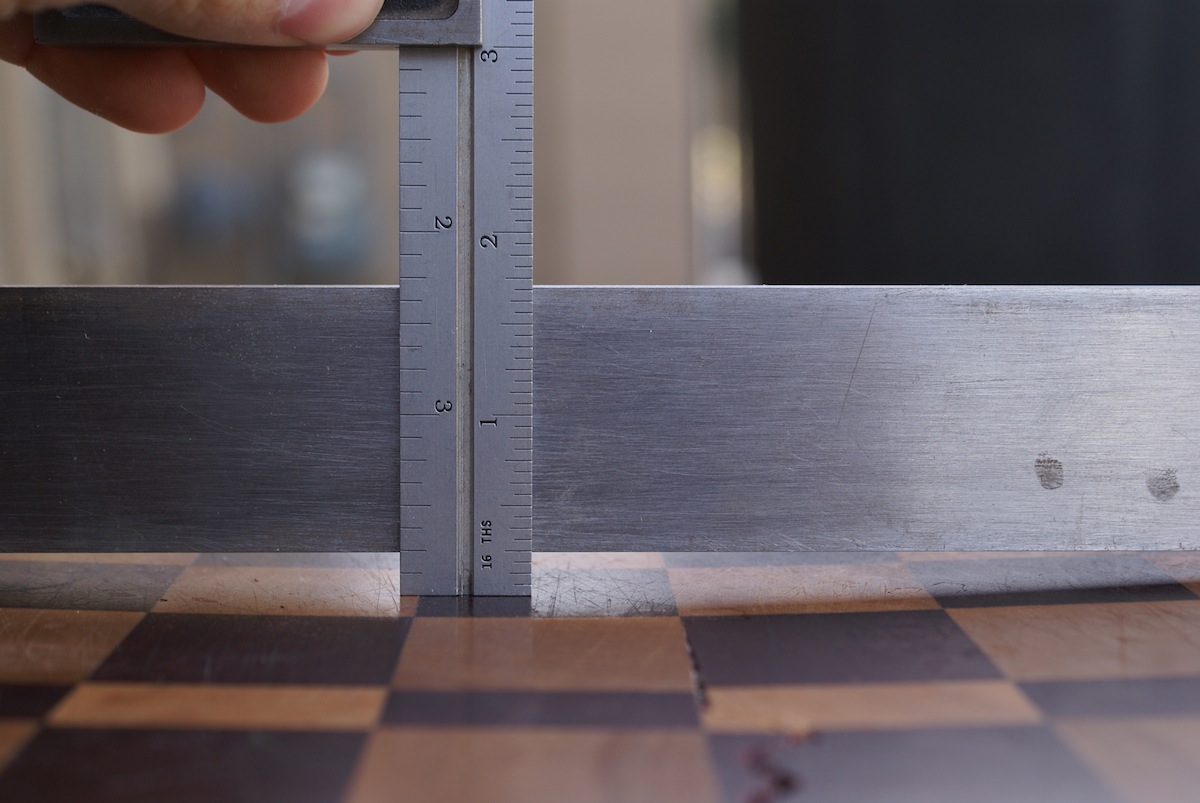
Cutting Board Warping – Question of the Week
This week’s question comes from Tony, he writes:
“I recently made one of your cutting boards as described in Episode 7 – A Cut Above. No problems with the manufacturing or finishing process. I gave this as a present to somebody and about a week later they returned it to me. The board had bowed & buckled in the center, about 5/16” (big central high spot on one side, and depression on the other. The board was made from Jatoba and Beech, using a water proof PVA glue. OK I thought, maybe the dissimilarity in the woods was too great (beech SG64 & Jatoba about SG80), so I have just made another board this time using Beech and Walnut and using a polyurethane glue. Whilst belt sanding I noticed that this board is also starting to buckle the same way the first board did (1/8”). It is now being clamped and flattened again. I was wondering if you had ever come across this type of problem before? All the timber is kiln dried and between 6-8% , the only common factor between the two boards is the use of Beech, but I have been using this batch of lumber for other projects without any problems.”
And here was my reply:
“Hey Tony. It should ease your mind to know that this happens all the time. There are many reasons for it. Moisture, jointing inaccuracy, and of course, the X factor just to name a few. In many cases, these boards cup for no logical reason. The good thing is they can be straightened out to some degree. If you have a cup, you can overclamp it slightly the other way to straighten it out. Also keep in mind these boards will move a lot over the coarse of time depending on their usage and the way they are cleaned and dried (be sure the user is drying the board on its side). In fact, last week my board had a 1/8″ cup to it after cutting a hot piece of meat. I just checked it today and its nearly flat again. Now with any luck, when your board develops a cup, it will face down (looks like a frown). This way the board remains nice and stable on the counter top. If it goes the other way it will spin. So you may want to put the boards in the reverse clamp for a week or so. Don’t be afraid to spray the board down with a little water before you throw it into the clamps. That will help to “reset the memory” of the board. Then hope for the best. As long as the board is sitting with the cup down, 1/8″ is really nothing to worry about. Wood generally does not want to stay perfectly flat all the time. If your recipient wants something perfectly flat, I recommend plastic. :) Good luck!”
Comments
21 Responses to “Cutting Board Warping – Question of the Week”Speak Your Mind and Maybe Win a Prize!
Leave a comment and you could be a winner in our Wood Whisperer Giveaway!And if you want a pic to show with your comment, go get a gravatar!


I’m not sure how the ones on Marc were made, but I have done all mine by turning the endgrain up, and I haven’t notice any warping at all and it will take knife cuts better.
A friend of mine had made a door to a sink unit out of birch. The doors were glued together much like the cutting board, end grain out. When he hung the doors, and coated them with polyurethane the doors arched out almost 2 inches over a 2 foot length. Once the other side was treated it settled back to being perfectly flat. It appears that certain woods can absorb wood and expand part way through, “cupping” the part.
If anything, try wetting the other side, they probably used one side and washed one side more then the other which caused it to expand at a greater rate then the other.
“…I recommend plastic”. Blaspheme!
I can’t imagine how anyone could receive such a wonderful gift, obviously made with love, and then return it for any reason. Personally I don’t think I could do anything like that.
Sure those of us who work with wood strive for perfection and strive to improve our skills. But I’m not sure that excuses this appalling lack of courtesy. When I was a child my parents taught me that when I was a guest in someone’s home and they served something that I didn’t like, I should take a small portion and under no circumstances make an announcement that I didn’t like the _____.
In this case I think plastic is too good for them.
Time to get off my soap box.
I have also made the Spagnuolo special. I have not had any bowing but it so pretty that my wife refuses to use it. I use it when I cook and have no problems. I did find that when I was applying the salad bowl finish that I had to switch from a thinned with mineral spirits mix to a full strength mix or else the finish seemed to fade out as it dried.
I’m using a Watco salad bowl finish on my cutting boards. The instructions specifically say, “Do not thin”. Therefore, I didn’t thin it. Perhaps the finish Marc uses requires thinning or works OK when thinned while others do not.
I build cuttingboards and i must say i have seen this issue! End-grain, face-grain, flat0grain, they all move. The trick is to make the board single sided (meaning one side has rubber feet). That way as long as the board does not have too much excessive bow, the feet can be adjusted to compensate.
http://uniquecuttingboards.com
ALexander
Mine have the rubber feet which is probably why i have never notice any warpage. I think Alexander is right on.
Yes thanks
One thing I notice when I make cutting boards professionally is that when I run them thru my drum sander I have to make sure that I flip the board EACH pass thru the sander to prevent one side warming up and warping while it’s being sanded.
Because I like the idea of having a reversable boards don’t bore holes into my boards. Instead I recommend people add the peel and stick type of rubber feet to their boards that come in a pack of 16 at your favorite hardware store.
The professional chefs that use my boards at our local fancy grocery test kitchen put a wet cloth beneath the board while they use the boards. This helps keep the boards from moving around while in use and promote even expansion.
I always recommend people dry their boards on end and avoid direct exposure to sunlight.
The other biggie is that I only get calls in March regarding boards cracking. This happens because people forget to season their boards. If you use a Beeswax/Mineral Oil Conditioners it will help to keep too much moisture from soaking into boards. The beeswax causes water to bead up on the surface of the board and the mineral oil soaks in, forming a protective barrier.
The problem is that when the furnace is running the boards will shrink when not seasoned regularly. So, when the board gets exposed to water it expands rapidly like an overdry sponge causing the bowing, warping and cracking.
Hello,
I use birch plywood for my paintings, and I seal all my wood with JW Sealer before painting with acrylics. I am having bowing problems and wondered how to keep the wood flat?
Thank You!
Hey Jody. Certainly plywood just has a tendency to bow. The cheaper it is, the more likely this is to happen. If you can, get ahold of baltic birch ply. This material has a bunch of plys, which helps keep things stable. Then make sure you seal both sides of the board. That should great increase your chances of keeping it flat.
Your butcher block video was very clear, thank you. I am about to make 52″ x 60″ counter top for an island in my kitchen is one large butcher block. The cabients are oak and I will be staining them I believe in a cherry walnut. What do you recommand for wood on the butcherblock? Also, can I stain the wood or will that effect it’s use as a cutting board. Lastly, do you believe that end grain as you did will stay together as a 52″ x 60″ x 1.5″ piece.
Hey Rick. I will always recommend hard maple as the primary wood for butcher blocks. It is really perfect for the task. Its easy to obtain, its tight grained, its dense, and its very durable. Other woods will work, but I think maple really does the best job.
I would not recommend staining it. The board is going to be used and abused, and you really don’t want to ingest any stain pigments or particles. So I would absolutely forgo the coloring agents. Keep in mind that maple endgrain is quite a bit darker than face grain, so you might not find the color variation to be all that dramatic from the cabinets.
And yes, it should stay together. But I will admit that I haven’t done anything of that size, and there may be concerns about wood movement. Some butcher blocks have metal rods going through them that support the structure and can be tightened if need be. You should also pay close attention to grain direction. Try to keep the grain in alignment so that expansion and contraction occurs in the same direction. Lastly, just do a little homework on larger butcher blocks. There may be some tricks of the trade out there that I am not aware of, and its good to be completely prepared.
Good luck.
I recently purchased an antique butcher block which needs some restoration. The first thing I need to do is tighten the metal rods. Can you tell me how to do this?
Hello Hope. Unfortunately, without seeing what you are working with, its hard to tell you how to tighten the rods. My guess is there must be some hex head or nut of some kind that you can turn. But again, without seeing it its hard to tell for sure.
There are some wood plugs that cover the rods. If I can remove them would I just need to tighten the nuts and put the plugs back in?
You got it Hope. Just don’t use glue or anything on the plugs because you’ll need to get back in there some day.
I want to make a cutting board out of one solid piece of wood. Most of the patterns I have looked at are at least 3 pieces glued together. Is it impossible to do this type of cutting board. I realize that warping is the issue….just wondering if it can be done.
Thanks,
Beth
Hi beth. It can definitely be done. But your instincts are dead on. The issue is potential movement. To stack the cards in your favor, you may want to try using rift-sawn or quartersaw boards, as they tend to be more stable.
Good luck.
Love your videos, I myself have made a few boards, I do not make them for one side use, if one starts to dish I put that side down. I find that if I run the slices after cuting the glued boards through the drum sander on each glued side I can get a much flatter and better jointed board after glueing up the final board, I also try not to make any joints less then a half inch minimum brick pattern for a stronger board :>)