This article was inspired by a question from Chris. He writes:
I have a couple of questions on making panels. Is there a rule of thumb as to how many pieces you should make your panel from for tabletops and the like? Also, some woodworkers say it is not necessary to alternate the cup of the wood if the panel is not too wide. Is this true? Thanks Marc, I love your blog.
As far as I’m concerned, there is no rule of thumb for board width when making a panel. It just depends on your equipment, your boards, and the appearance you are going for. But make no mistake, cutting your boards into narrow strips will indeed increase the stability of the panel. It also does one other very important thing: it makes an ugly panel! Well, at least its ugly to me. Some people may very well like a table top that looks like a gym floor. I, however, do not.
So if the wood is stable and dry, I try to keep the boards as wide as my equipment will allow. We just don’t see much furniture made with really wide boards these days, and I think its a real shame to cut boards down any more than necessary. Of course, that does mean there is an increased chance of cupping. But this is usually a risk I am willing to take for the sake of aesthetics. Keep in mind there are always ways to reinforce the top and discourage cupping, such as breadboard ends and cleats.
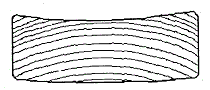
Now before we go much further, we should cover a little background. Understanding why and how wood cups will help you plan your furniture with stability in mind. When looking at the end grain of a plain-sawn (flat-sawn) board, you’ll notice that the growth rings usually curve up or down. And lucky (or is it unlucky?) for us, you can pretty much predict which way the board will cup simply by looking at the orientation of the end-grain. As you can see in the drawing to the right, the wood typically cups away from what would be the center of the tree, or in the opposite direction of the growth rings. Perhaps in the future we’ll dig into this even deeper and discuss the differences between tangential and radial shrinkage, which is the ultimate cause for this phenomenon. But for now lets just say that the cupping occurs when one side of the board shrinks more than the other. And in a plain-sawn board, the shrinkage is predictable, and as a result, so is the cupping.
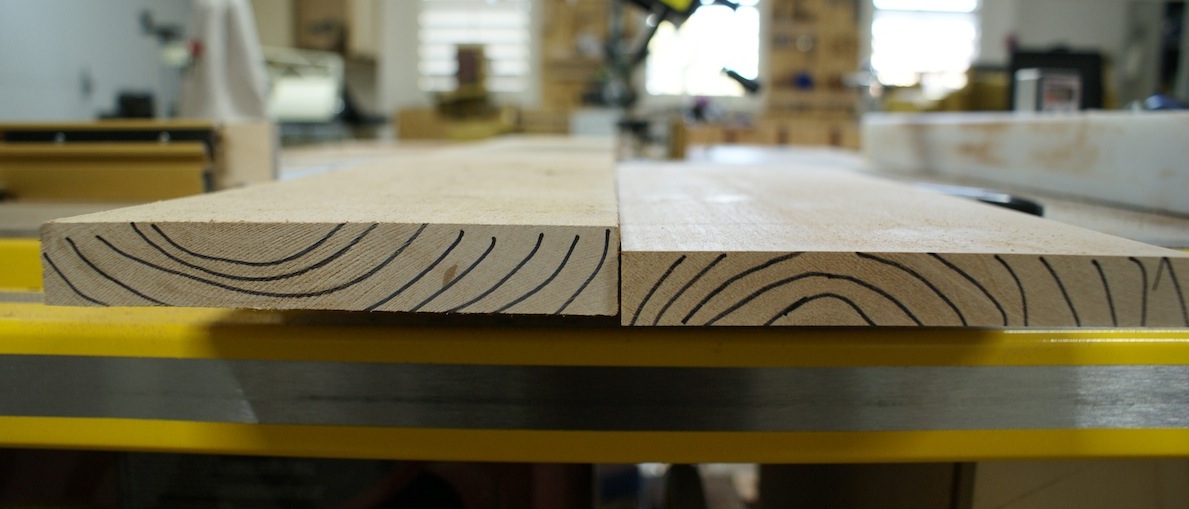
So when gluing up a panel, should you alternate the grain, one up/one down (pictured left)? In my opinion this isn’t necessary, but it is important to know the inherent risks and what may happen if you don’t. If the boards do decide to cup, the effect is greatly exaggerated when the boards all have their grain in the same orientation. So let’s think about what may happen if each board in a row of five cups by about 1/8″. The cumulative effect would be a very wide curve across the length of the panel and you’ll be on your way to making your very first barrel. Congratulations! You’re a cooper!
So what happens if we alternate the grain instead? Well, we aren’t going to stop the individual boards from cupping. But if one board cups up and the next board cups down, the overall effect on the panel is canceled out. The end result would be a much less noticeable issue. So while its not necessary to alternate the grain, doing so could very well lessen the effect of unexpected cupping.
I can sum it all up by saying I keep aesthetics as my #1. To me, wide boards are just aesthetically more pleasing. And I do alternate end grain orientation when possible. But my first concern is making sure the face grain of the boards looks great. I will never sacrifice the appearance of a panel’s face for the sake of alternating end-grain. Now if you are really concerned about your panels staying flat, I suggest you look into Quartersawn wood!
I would love to hear your opinions on these issues. Do you alternate grain? Do you trim your boards down for stability?



31 Responses to “Avoiding Cupped Panels”
“Congratulations! You’re a cooper!”… Sweet. I gotta’ remember that one!
I loved that line too.
One of my woodworking buddies, who is actually studying cooperage, might disagree… :)
The whole topic of form vs. function would be an interesting discussion to read some time. While I agree for the most part that aesthetics should be of primary concern, I also think that much of what adds to the beauty of a piece of furniture is how well it performs the intended function for which it was built. As you stated there are ways to compensate for wood movement. However, these may or may not fit into your design. I also think about this from a historical perspective. How much of what might be considered aesthetically pleasing today grew out of mere function?
Sounds like we are getting off the subject, but as far as cooperage goes, a barrel stave is curved in two directions. Or at least the classical barrel with the “bulge” in the middle, and the staves are deliberately curved. I’m not suggesting that coopering is a “cut-and-dry†process.
I’ll have to go with Marc on this one. I think aesthetics should hold sway as possible. Then for me, the question is, what is the probability that the panel surface will cup any time soon if the end grain is all oriented the same way? I understand that the answer to this is subject to a number of factors. I’ve seen beautiful table tops made out of a single very wide piece of wood with wane edges, but I ask myself every time I see one of these, is will it ever cup?
Marc suggests a couple of ways to restrict cupping. I’m also wondering if the cupping goes down as the board thickness goes up? I look forward to a discussion on preventing cupping in panels or table tops, as well as the factors that cause this.
The question is not whether the panel will cup. The question is whether the panel will move. Wood movement is inevitable and as such should be addressed when making a panel.
A question for Marc that should shed some light on his choice to alternate grain direction would be : “Do you include a mechanism for handling wood movement in panels when you alternate as well as when you don’t?” The reason this is important is that if you don’t address wood movement when you alternate the grain direction, aren’t you saying that it DOES matter which option you choose?
Hey Jim. I am not completely sure I understand what you mean. The wood is going to expand and contract the same amount regardless of the orientation of the board, right? Could you explain a little more because I am sure I am misunderstanding what you mean.
I’m trying to say that if you include cleats on panels that aren’t alternated, and it doesn’t matter if you alternate the panels, then I would expect you to also include cleats on panels that are alternated. The reason is that all panels move and to be consistent, you manage the movement regardless of whether you alternate the grain direction or not.
Oh I see. Well if the design of the piece allows for it, I will include some form of stabilization for the top, regardless of the board orientation. But like Chad says above, not all designs are going to allow for it. So on those pieces, I might pay a little more attention to alternating the grain. But in most situations, its a secondary concern for me. I arrange my boards first getting to most attractive look possible. From that point, I will move things around and see if it still looks good after flipping a board or two in an effort to get an alternating pattern. If it doesn’t look good, I go back to my original setup and I don’t worry about alternating the boards.
That’s what I do also. I deal mostly with small panels and I find it best to stabilize the panel whenever possible. Thanks again Marc and Merry Christmas.
I feel that if you alternate the grain you end up with a wavy board instead of a cupped board; neither one is good. I think the main secret is to work with stable wood. You can do a number of steps or techniques to have the most stable wood possible. The first step is at the lumber yard. Pick out the straightest, flattest boards you can. Then give them plenty of time to adjust to the humidity level in your shop. If possible try to keep your shop the same humidity as where you furniture will end up; I realize this is not always possible. Then you should cut it to rough dimensions and let it sit for a few days before you dimension it to its final thickness and width.
If all else fails cut it into veneers and glue it something stable like MDF.
I’ve seen seemingly straight boards peel off like a hot wheels track when I ripped them. One thing I do is to cut and rip pieces close to their final dimention before I mill them. Let them sit a bit. Join and plane, leaving them heavy. Let them sit. Then do a final mill, sometimes rejoining them. Not so worried about face frame parts or moldings as they are pulled to the carcass anyway. It’s the doors that will get you, especially long ones. If I have doors that are over 4ft long, I baby those stiles. Another thing I like to do is put an arch grain pattern on raised panels. I might start with a wide rough board (I’ve had mahogany boards 16+” wide) But I make them more stabile by ripping them down, milling them and gluing them back together in the same orietation. Often you need to shift them to account for the kerf, but usually the joint disappears.
Would finishing both sides and all edges of the wood help prevent environmental changes from causing the wood to cup? What sort of finish would be best for this?
Pretty much any film finish will help as it slows down the transfer of moisture into and out of the wood. And protecting the end grain in particular is helpful. To be honest though, I don’t know if one film finish is better than another in this regard.
Hi, living here in Livingston, Guatemala the humidity is always in the 75% range, I use both soft and hard woods for my projects, when I seal the wood I use SUR NITROCELLULOSE SEALER, about $27.00…
This product dries to the touch in about 15 minutes, sands very well and recoats in about one hour…
Now you can’t use this when it’s raining, the moisture creates a fog in the sealer, other than is, I am totally satisfied using this product as a sealer and finish…
Alternating grain direction and wavy instead of cupped just never seems to look good to me.
I’ve seen that recommended all the time, but as you said, aesthetics are #1.
Marc mentioned using quartersawn lumber somewhat with tongue in cheek, but whenever possible, I sort through hardwood stacks to locate vertical grain whenever possible. Or at least, rift sawn. Even with slab-sawn lumber, there are always a few slices through the center that are equivalent to quartersawn, or close to it. Sometimes I have to visit several lumberyards to collect what I want, but if it’s an important piece, it’s worth the effort. Of course, the wider the boards, the more difficult it will be to find vertical grain.
An added benefit is that quartersawn wood will often show better figure than slab sawn–such as the curls in maple.
DD
To what degree will quarter sawn mitigate the risk of cupping or other movment from moisture?
Of course, some species of woods are more stable, and others are more likely to warp. And some wood with twisted grain will never be stable, but all things being equal, I believe the better the quartering, the more stable the wood.
I have some ten inch wide spruce and cedar guitar top wood that is only 1/8″ thick, but is perfectly quartered. After 20 years it’s still dead flat.
DD
Oh yeah, and I am getting spolied with the voice answers to questions in the guild…Man I have to read!
Great question. I am actually getting ready to start building a table myself and had questions as well. Does it matter if the boards for the top all vary in width? I bought some black walnut from a guy who has had it for over 40 years and the width of the boards are between 5″ – 7″, I hate to waste the wood if I don’t have to. Also what is the best method for joining panels? This is my first real project, sorry if I ask basic questions.
Hi, I make a lot of small table tops from a wood called Santa Maria, it’s a hard wood, reddish-brown in color…
All the wood I use is chainsaw cut about 1/14 thick and 12 inches wide and brought to me wet, I sticker it in the open air for about 4 months…
I Then will rip it lengthwise in half, let it set another week or so(if the board feels cool to the touch, I let it dry more)then plane to dimention, I place best side-up, biscuit and glue the boards into panels…
I made me a 3 foot sanding block with a 50 grit belt sander belt glued to it and sand crosswise of the grain until I’m satisfied, then power sand to finish…
I myself really like the look of multiboard panels, they are never boring…
You mentioned using breadboard ends as a way to keep panels flat. I think it would be great if you did a video or blog post on how to make breadboard ends.
I like the comparison to a table top looking “like a gym floor”. That really resonated with me. I look at mass marketed furniture whenever I can. I’m starting to see table tops and bookcases made from short, narrow pieces glued up to make panels. Of course the result is it looks like a gym floor.
I think the vast majority of consumers are now so far removed from what quality furniture really should be, they don’t know and they don’t care. So, the gym floor table is just fine with them. (At least it’s solid hardwood and not contact paper or plastic over MDF.)
As woodworkers, we have the opportunity to make more traditional, high-quality pieces. Thus, I agree with Marc about using wide boards whenever possible. Even people who nothing about furniture can look at such piece and appreciate it.
Marc Spagnuolo:
I can’t help but notice that during all this discussion about cupping, no one has made any mention about wood species. Some cup more than others. Pine Vs. Walnut for instance. I would flip every other board when using Pine. But with Walnut I may not. Am I wrong in this train of thought ?
i commented on this topic in another page of this website and i would like to elaborate on the topic,i cant bring myself to ripping up beautiful planks flipping grains and regluing back together ruining the look of a beautiful and expensive board,old growth wood with tighter growth rings is much stabler and less pron to cupping also if you put curf cuts on the under side of the top approx 1/2 the thickness of the top but dont go all the way to the ends, stay back of the cabinet sides or end rails being careful not to put them where the screws will be placed this will greatly reduce the stress on the screws after all a cupped panel3/8″ thick layed on your bench is much easier to press flat then a 3/4″panel also breadboard ends will help prevent cupping,i also use intermediate rails moritised into the front&back rails so i can screw up into the center of the top since in my opinion the best side of the top is usually the side closest to the center of the tree and in this orientation the center of the top will want to crown, also appling the same amount of finish on both sides evens out the obsorbition rate of water, in our northern climate moisture in wood will fluxuate seasonally somewhere between6%-12% speaking of moisture its time to go shovel some snow paul hfx nova scotia
So, would it be completely overkill to use breadboard ends and quarter sawn lumber for the panel?
Not if the design calls for it. But I wouldn’t force breadboards into the design if its not really appropriate.
In making a butcher block counter top I’ve seen people rip the stock and then rotate it once(on to it’s side) and glue together in this fashion. Why rotate the stock? This would make the cupping effect be at the joint that is laminated. Did I explain this well?
Well the point of the rotation step is to make sure the end grain is facing up. The end result is a more durable cutting surface. It doesn’t really do anything to increase cupping. In fact, it probably winds up making it a little more stable over time.
Thank you sir. Now to the planner…