
Assembly Table - Project of the Week

April 26, 2008 | Filed Under Blog, Project of the Week 

This week’s project comes from Patrick. My poor little assembly table is cowering in the corner with its tail between its legs. lol. He writes:
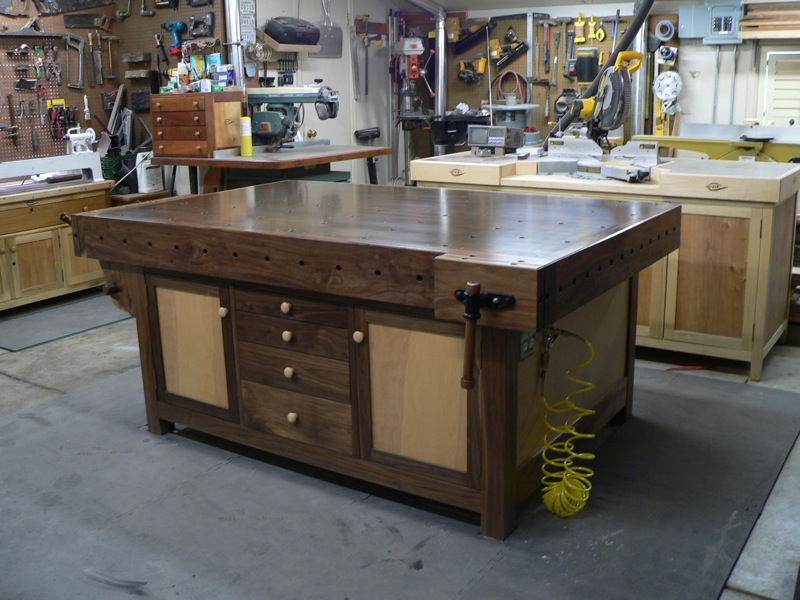
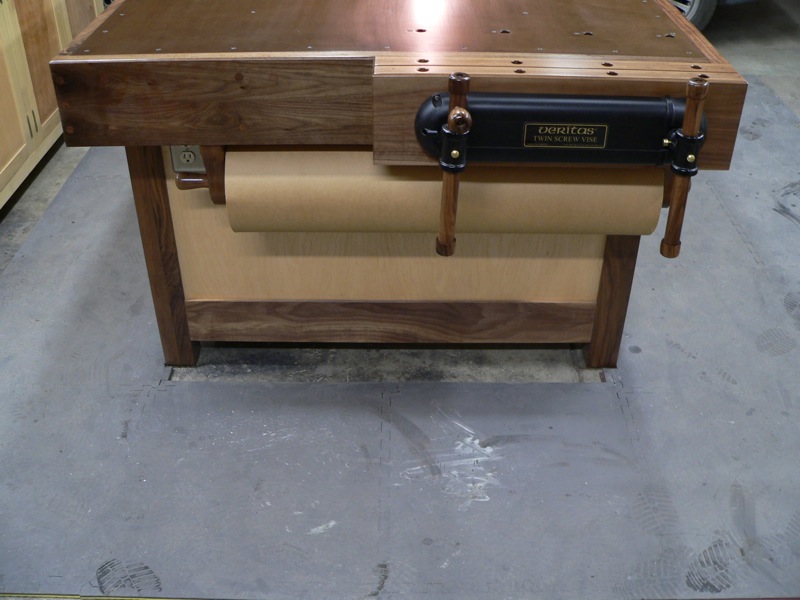
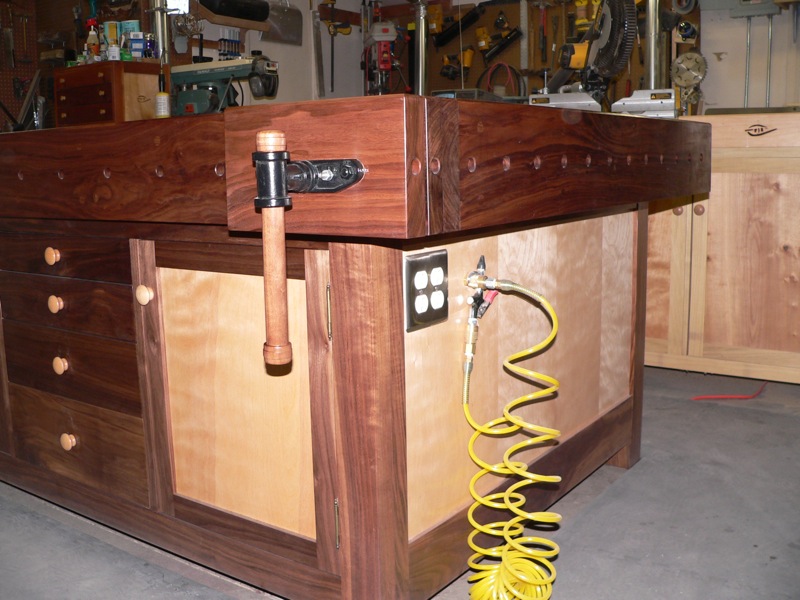
This is my take on your assembly table. I had been contemplating what to do for a replacement bench for a couple of years. It was not until I saw the assembly table you built that I decided to combine the features of a work bench with the features of an assembly table. It was this idea that actually ended up saving space despite the fact this new bench is larger than the two it replaced combined. It measures approximately 81” x 51” x 36.5”. The base is walnut, the panels are birch ply and the joinery is mortise and tenon. The top is a seven inch thick torsion box, wrapped in walnut, and includes two vises with the requisite bench dog holes. The bench dog holes presented a problem because I did not believe MDF would be substantial enough for the dogs to react against. Therefore, I glued walnut blocks in wherever a hole was intended. Blocking the dog holes also had the added advantage of not turning the top into a time capsule for every small part I set on the bench. Finally, I have a surface big enough to assemble a large project without the assistance of shims and saw horses.
**UPDATE** Patrick sent in a Sketchup file that details the construction of the torsion box and the role of the solid wood dog hole supports. Download Sketchup File

Comments

29 Responses to “Assembly Table - Project of the Week”

  1. RJ on April 26th, 2008 4:12 pm

    You very well may have made the perfect bench my friend! Nice work to say the least!

  2. Jeremy (Bama5150) on April 26th, 2008 8:13 pm

    That is the most beautiful thing i have ever seen.

  3. Vic on April 26th, 2008 9:39 pm

    Man oh man oh man, that is NICE!!! Gorgeous workbench/assembly table! I am jealous!!!!

  4. Matt on April 26th, 2008 10:04 pm

    Make me one please!

    Or how about a detailed entry and more photos on a lumberjocks post?

  5. alexander on April 27th, 2008 6:37 am

    That bench is Too nice to use. Absolutely gorgeous. Have you checked it with a straight-edge to see how flat it is?

    Thanks for the pics

    LAtes

  6. Bob A in NJ on April 27th, 2008 1:22 pm

    Wow, extremely impessive bench. Like a new car, I’d hate to put the first dent in this. What finish did you use?

  7. Jim Jones on April 27th, 2008 6:15 pm

    It is beautiful. How can you bear to use it. -LOL- I’ll bet it ends up taking even more space because you’ll surely have to build one that you can use. This one should be kept for show!!

  8. David (runningwood) on April 27th, 2008 8:25 pm

    That is really beautiful. Do you ever plan to move ?
    that thing is definitely going to have to stay, how much does it weigh ?, how will it fit through the door ?

  9. David on April 27th, 2008 9:21 pm

    That is one beautiful workbench, that would look great in my living room !

  10. Craig on April 27th, 2008 10:28 pm

    wow! That is the best looking assembly table I think I’ve ever seen. Well done! Nice veritas vice too! What do you estimate your total cost was? How much time did it take you to build it?

  11. Eric on April 28th, 2008 5:27 am

    That’s just !@#$’n nuts! Great job though. I am jealous…

  12. Scott on April 28th, 2008 7:53 am

    Great looking bench/assembly table!! Could you explain a little more about the bench dog holes? I’ve been curious about how something like that would work in a torsion box…

  13. Rob on April 28th, 2008 7:55 am

    Very nice… How about some plans? :)

  14. Mike on April 28th, 2008 8:26 am

    Dang!!!

    Enough said

  15. Claude Stewart on April 28th, 2008 9:06 am

    Wow, I myself hoard my walnut. You could also probably use it for you dining room table, certainly looks like it. Beautiful. Claude

  16. Matt on April 28th, 2008 5:10 pm

    That is awesome! Many kudos to you. If I built an assembly table that looked like that, or even had the ability to, I wouldn’t be able to use it. I’d spend a lot of time looking at it and not getting any work done.

  17. Brian M. on April 28th, 2008 10:58 pm

    marc, that thing prerry much owns your assembly table, and thats not a slight at your table. wow.

  18. Kip on April 29th, 2008 2:10 pm

    Incredible! I only aspire to have an assembly table that nice. Wish I had room for it as well.

    Kip

  19. thewoodwhisperer on April 29th, 2008 3:09 pm

    Download Patricks detailed Sketchup file to see how the dog holes were reinforced: http://thewoodwhisperer.com/torsionbox.skp

  20. Bruce on April 29th, 2008 3:59 pm

    Is it a SIN to Covet thy neighbor’s bench? Forgive me for I have!

    FL Wood Rat

  21. Pat, a.k.a. Patrick on April 29th, 2008 8:12 pm

    Thanks for the kudos I really appreciate them. It’s not often that one receives such positive commentary in my 9-5 profession.

    Now to answer the questions posted thus far. I used shellac on the base and lacquer on the top. No, I have not put a straight edge on it at least since construction of the torsion box was complete. I assure you the curve detected in one of the pictures is from the camera’s lens and not a lack of flatness. Yes, it will fit through doors as long the removable top is removed, the doorway is at least 29” wide, and you have hired at least 4 professional movers. I started construction of this bench the week between Christmas and New Years. I worked on it over weekends and a few evenings per week and completed it in about 3 weeks.

    As for the total cost of the bench, I hesitate to say, it was actually very inexpensive. Much of the material originally intended as bridge timbers. Additionally, most of the material is from the same tree.

    Yes, I use the bench regularly and have made an auxiliary top out of masonite for the occasions I weld on it. No I am not kidding. But I have yet to burn a bench and I have been welding for many years. I cannot say the same for the auxiliary tops I have used.

  22. Pat on April 30th, 2008 11:06 am

    Umm mine looks like crap to me now! I am finishing the torsion box today and have yet to decide if I want to use maple or oak to frame it with… decisions! Then again I could start over and… nah!

    I too would be afraid to use this. What a beauty! My only concern is how practical the paper roller is with its position relative to the vise (why didn’t I think of adding a vise! - LOL). I am very impressed.

    Mine follows Marc’s plans more to the letter than this, with a few exceptions. I will send to Marc when done and he can post if he wants…

    Nicely Done,

    Pat

  23. Pat Boyd on April 30th, 2008 1:55 pm

    One more question on this. Is that top hardboard? And you finished it with lacquer?

    Pat

  24. Pat, a.k.a. Patrick on April 30th, 2008 6:58 pm

    Yes, the top layer of the top is hardboard with a lacquer topcoat.

  25. Roland on May 2nd, 2008 11:17 am

    Marc, thanks for giving us another place for ideas like this to flourish. Pat, I love your bench.

    I was about to finally start on a basic torsion box thinking that in the future, I could use the basic box to help with the construction of my ultimate workbench. After seeing your dressed up workbench/assembly table, I am trying to figure out if I can start on the basic box and then dress it up if I can get some more info about your bench. I have a million questions, here are the first ones that I can think of:

    1) Can the bench be built in phases like; basic torsion box, dressed up apron and top, then vises?

    2) Is the torsion box a full 7 inches or is the box about 3 like Marc’s and the apron is oversized?

    3) Did you use mdf under the fancier stuff and if so, what size for the top and bottom and what size for the stringers?

    4) Did you add the vises later as your project evolved or is it important to buy the vises first and study their requirements?

    5) I see a comment that the top is hardboard, is that 1/4″?

    6) Is that over a 1/2″ mdf top?

    7) Do you think that using plywood for the top and bottom might add enough strength to eliminate the requirement for the blocks of solid hardwood?

    8) Can you detail how you installed the vises?

    9) Do you think that blocks of KD HF like the 2×4 material could be used for the reinforcement blocks for the dog holes and also to help support the vises?

    10) I guess my first question should have been,”Can you give us or sell us some detailed plans for your bench?”

    Thanks in advance for any help you can provide!

    Roland

  26. Pat, a.k.a. Patrick on May 3rd, 2008 7:45 am

    Roland:

    1) Yes, the bench can be built in phases. With that said, I would be concerned that the torsion box may get damaged if the edge was left unprotected for too long. Additionally, due to the problems presented by adding vises to this type of top your planning must be impeccable.

    2) The torsion box is a full 7” thick. Although, if your apron is thick enough material I see no reason why one could not do as you have suggested. In my case I took into account all of the pros and cons to each option and decided making the top a full 7” thick would best suit my needs.

    3) If you look at Marc’s Assembly Table video you will notice he used ½” and ¾” MDF. Please do not read anything into what I used in my top because I was limited. The suppliers in my area do not stock ½” MDF. Therefore, I used only ¾” MDF. I would suggest using ¾” for the top, bottom and perimeter and ½” for everything else. Reduce the weight wherever you can, within reason.

    4) It depends on whether or not you are going to make the torsion box the same thickness as the height of your jaws. More specifically, if the path of the vise screw is going to travel through the torsion box, as opposed to under it I would advise you to get the vises in advance. You can get the specs on a vise in advance but in my experience that is not a replacement for having the hardware on hand because far too often something is not taken into account or the specs are incorrect in some minor way that results in a big change in the plan. If you plan to make the torsion box thinner than the wrap and the vise screw will travel beneath the torsion box having the vises in advance is far less important.

    5) Yes, ¼” hardboard.

    6) No, I used ¾” MDF. All that is available in my area is ¾” MDF. Absent my MDF supply limitations I would still use ¾” MDF for the top and bottom of the torsion box.

    7) The reason for the solid wood blocks is because the dogs extend below the MDF when installed and if I understand your question correctly the use of ply instead of MDF would not solve the problem. The forces exerted on the bench dog without the blocking would cause the dog move too much in the hole and result in a worming out of the hole and ultimately ruining the top. Now that does not mean one couldn’t use something else other than solid wood. For example you could laminate MDF but I did not because I wanted the dogs to have the end-grain to react against. My thought was that the end-grain does not compact as easily. Therefore, the blocks were installed in my top so the grain is oriented to correspond with the direction the vises travel.

    8) Hopefully it will suffice to say the vise screws travel through the cell walls of the torsion box top. Additionally, vises generally come with instructions for installation and I believe it is safe to say the instructions will not cover the installation in my situation. This is why I believe it to be incredibly important to have the vises and take all of the requirements of your vise into consideration when constructing the top if you intend for the vise screw to travel through the torsion box. I am unfortunately doubtful this written explanation will be very helpful.

    9) Unfortunately I do not know for certain what you mean by “KD HF” but I would not use 2×4 material if you are referring to pine, furr, pressure treated, cedar or redwood 2×4. Please clarify the question if I misunderstood.

    10) No, unfortunately I cannot provide what does not exist. Unless it is a commissioned piece I do not generate a plans. All of the plans for projects built for myself or family exist only in my head. Somewhat like building on the fly.

    I hope this helps.

  27. Roland on May 3rd, 2008 9:18 am

    Thanks for the quick response!

    Regarding #9, the KD HF refers to a kiln dried Hem Fir that is inexpensive and readily available. Being kiln dried, and inside the torsion box that would be sealed with laquer, I was hoping that this cheaper wood could substitute for the blocks of 1-1/2″ walnut that you used for the dog hole reinforcements.

    For those of us without an available supply of bridge timbers, is there anything else that you would suggest for the dog hole reinforcement blocks? I was also thinking about mounting the vise under the bottom of the torsion box and (I think) through the oversized apron-assuming that I do this in phases.

    Thanks again,

    Roland

  28. Pat, a.k.a. Patrick on May 3rd, 2008 12:03 pm

    Roland:

    One thing you may want to take into account before you commit yourself to mounting the vise screws below the torsion box is that this could result in vise jaws that are too tall. that is the distance from the top of the vise screw to the top of the jaw is too far. Resulting in a jaw that is subject to breaking easily.

    Fir ought to work just fine. I might use something harder. Also, I typed up my responses to you questions earlier so quickly I did not catch my spell checker had changed fir to furr.

  29. Roland on May 3rd, 2008 2:17 pm

    Fir, Furr, Fur - What’s the difference?

    Thanks again.

Got something to say?


  • What's New???

  • Check this out!!

    Loading the LumberJocks Widget
  • Extra Reading

  • Google


  • SuTree Videos

    Find free how-to videos
Close
E-mail It