6 Days to Aurora – Day 1
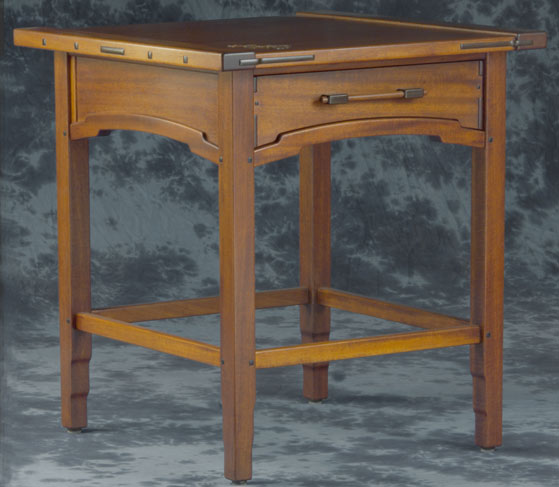
I have my camera and I have my laptop, so why not go ahead and document my class? Today was Day 1 of what I am calling “6 Days to Aurora”. We are building Darrell Peart’s Arched Aurora End Table: an incredible modern take on some classic Greene & Greene elements.
Day 1 was very similar to day 1 of any class anywhere. That is, the first half of the day was spent selecting and milling stock. We picked some fine mahogany boards (gotta go with the classics), and started milling stock for the legs, aprons, and drawer parts. That’s Brad (aka TreeFrog), cutting some of our parts to size.
Once the stock was ready to go, we began working on some of the leg details. The legs of the table feature this beautiful stepped “waterfall” on the inside face (where you might normally see tapers). Darrell had this great little flush trimming jig that made the job pretty easy. The jig looks incredibly easy to build too. We also cut our the mortises (all loose tenon joinery) and the square holes for the ebony plugs.

So by the end of the day, I had some sexy legs with holes in them and I feel like I learned a lot. What you’ll find in these group classes is that you tend to learn just as much from side conversations with the instructor and your fellow students, as you do from the class itself. It was great meeting Darrell and all I can say is thank goodness I have 5 more days to pick his brain! So far, I am truly enjoying my experience at the William Ng School. Oh and if you look closely at those legs, there are several square holes along the edge, the smallest of which is 1/8″!! Now that’s a tiny peg!!

6 Days to Aurora- Day 1
6 Days to Aurora- Day 2
6 Days to Aurora- Day 3
6 Days to Aurora- Day 4
6 Days to Aurora- Day 5
6 Days to Aurora- Day 6
Comments
12 Responses to “6 Days to Aurora – Day 1”Speak Your Mind and Maybe Win a Prize!
Leave a comment and you could be a winner in our Wood Whisperer Giveaway!And if you want a pic to show with your comment, go get a gravatar!


Looks like you are having a ball. Can’t wait for the final project.
I build custom furniture for a living and do a lot of flush trimming of parts using patterns and was intrigued by the huge bit you were using to flush trim the parts you guys made. Where can i get that bit? It seems a lot better than the 2″ tall, .5″ wide flush trim bit I am currently using.
Thanks,
Jared
From what I understand, that’s William’s bit. I will find out the story behind it for you tomorrow.
I sure could have used that big bit for the legs I made for an outdoor chair a few months ago. Any info you can get on it would be appreciated.
It looks like a lot of fun. Not being a woodworker by profession, I have a hard time justify woodworking classes, so it is mostly the free stuff I can get from the annual woodworking show, what I can find on the internet, and in books. I am living vicariously through you, so the more detail the better. I would love to see how the raised leaf pattern on the table top is done.
Yes, what kind of bit is that? I looks like a monster!
Mike
This is a beautiful table, it looks like a fun project.
I was curious about the mahogany you are using. Is it African Mahogany, or one of the more exotic (i.e. expensive) varieties? Whatever it is, it looks nice. I’m curious if there is a problem using African Mahogany for such projects.
We are using African Mahogany for this one. Well, some folks chose other woods like bubinga and cherry. But I went with African mahogany.
Looks like a great class and I really like the design of the table. I never realized that mahogany is traditional in Greene & Greene, but it really fits the style. I’d really like to take a woodworking class someday, but there never seems to be time for it. Looking forward to the next installment. Hope your having fun.
Oh, that’s one serious pattern bit on the router table!
It looks like a great class Marc – thanks for sharing.
Quick question: I have done a few projects that had square (pegged filled) holes, which turned out okay. However, I am curious if Darrell had any neat ideas on how to do this work easier – e.g., drill bit, pilot hole and cleanup with a chisel (very small one for a 1/8 square hole), chisel alone or a combination of both with a jig to keep things square. From my experience, I found it sometimes hard to make the mortise perfectly square and not being tempted to takeaway too stock away – making the hold too big (not matching the others).
I assume the answer is probably all related to better handwork, but I am curious if Darrell shared any techniques for making the process smoother.
Matt,
You need to get Darell’s book; he discusses the plugs (and the holes they go into) in great detail.
I saw mention of his book on Woodnet, and since getting it, it’s my favorite woodworking book. A great combination of historical perspective, design information, and practical woodworking instruction. I’ve become totally enamoured with G&G as a result (’caused me to make design changes part-way through a project).
FWIW, I like using a mortising machine chisel to start the hole, without using the drill bit with it; i.e., just use it like a regular chisel and tap it with a hammer. it gets the corners properly placed, and nice and square.
I’d love to get me one of them router bits. It looks like something you’d see on a shaper.
what we are using in the class are these special punches that Darrell had made up. They look like mini hollow chisel mortising chisels. A few taps and you’re there. I think most standard size holes can be done very easily with the standard square chisel from a mortiser. And for the large pegs, that’s exactly what we used.