That’s a Funny Looking Chisel


This question comes from Adam B. He asks:

Marc, I am watching your Entertainment Center Video (Pt 1) and noticed something odd with your large chisel. How did you flatten the back of it? It looks like there are three channels cut into it.
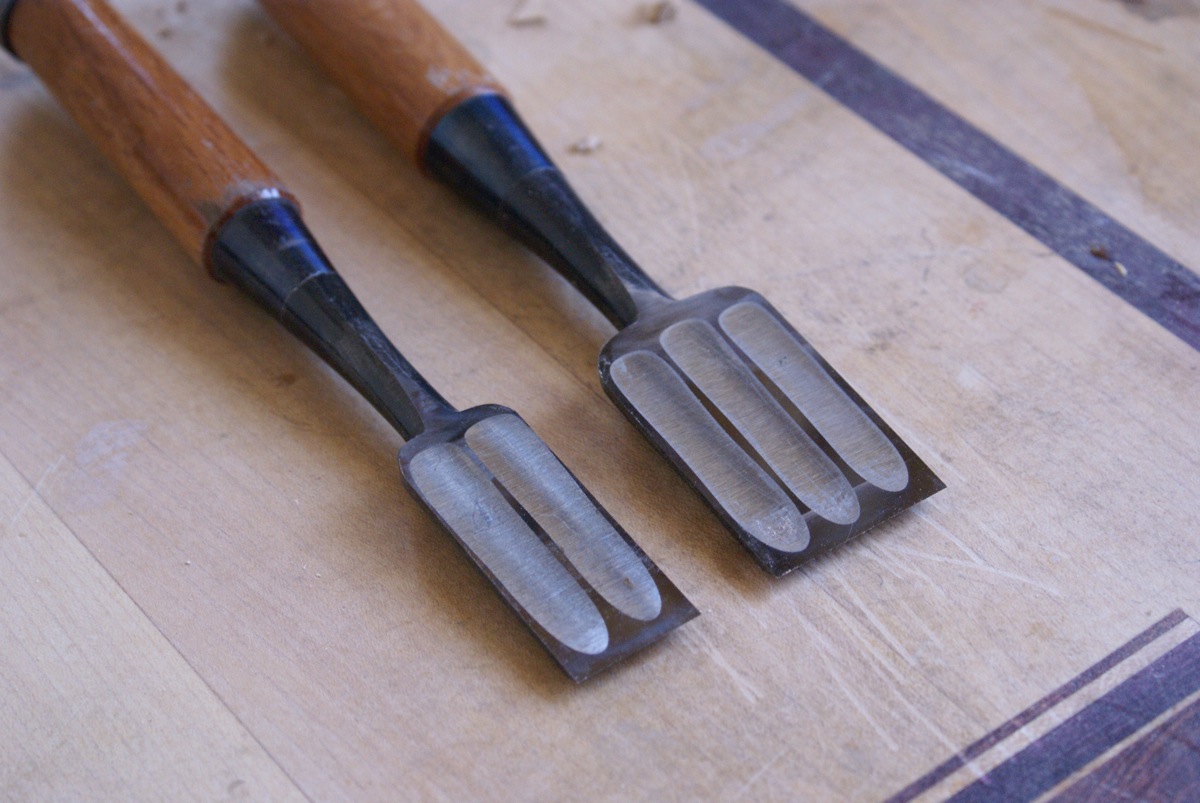
hollowbackThe chisels I use on the show (most times) are Fujihiro Japanese chisels. In general, Japanese chisels are made with harder steel than their Western cousins, which means it can take a lot longer to flatten their backs. And a flat back is an absolutely critical component to any chisel you actually intend to use! So to speed up the flattening process, a good amount of steel is removed from the back of the chisel. And as you can see in the picture, wider chisels can have multiple hollows. So now the actual amount of steel that needs to be removed in the flattening process is significantly reduced. Which means you are going to spend less time at the sharpening stone, and more time at the workbench.

hollow bevelThis is the same concept behind creating a hollow bevel. Many folks prefer hollow bevels because they can be easier to sharpen, not just because of speed, but because its easier to balance with two points of contact. FYI, some may disagree with me on this but this is just my opinion from my experience. So the hollows are a little unusual-looking, but they do serve a purpose.

I borrowed the image to the right from a great article on FineWoodworking.com called “Speedy Freehand Sharpening” by Hendrik Varjhu.


17 Responses to “That’s a Funny Looking Chisel”

  1. Chris says:

    I guess the chisels are no good after you sharpen your way back to hollows? So how long until that happens?

    • thewoodwhisperer says:

      Well, probably a very very long time. But if it does happen, you can always flatten the back again to re-expose new steel and create some distance between the edge and the hollows.

    • Jim Jones says:

      From what I’ve read and seen in chisel sharpening videos (Norton’s for example), the extremely flat portion is only required near the cutting edge so you can get the truly flat and sharp edge. The rest of the back just needs to be pretty flat. I guess that is mainly needed if you are paring.

      • Dan says:

        A true paring chisel is actually somewhat convex on the flat side. This allows you better control so the chisel doesn’t dig into the wood. But this kind of paring chisel is hard to find these days. Most of mine were made around the turn of the 19th century–back when all professional woodworkers still used hand tools. You can usually find the old chisels cheap at any flea market. And if they haven’t been sharpened down too far, will still cut with the best of the modern chisels. Plus you can often find them in odd sizes. In my shop I routinely use 1/8″ and even 1/16″ chisels.

        DD

  2. Tim says:

    Hey Marc,

    What sizes of those chisels do you own? I gotta say, whenever I see those fine chisels during one of your episodes, I say ‘damn, that’s attractive!’

  3. steven says:

    With those hollows on the back could they make it harder to register your chisel against a surface if you were per say paring something off?

    • thewoodwhisperer says:

      Only if you are paring something very skinny or very close to an edge. But for 99% of paring operations, it works just fine.

      • steven says:

        i have robert sorby chisels and tend to like the longer blades and handels, did you find that it took time to get use to the shorter blade lengths

  4. Dan says:

    Hard to sharpen too. You can’t just touch them up on a grinder, or give them a few swipes on a stone. But they hold an edge for a good long time.
    The steel is usually a lamination–with very hard steel on the flat side, combined with soft iron or steel on the body of the chisel. Supposedly gives you a blade that will hold an edge, but won’t break. In practice, I find them fairly easy to chip. But great for careful, fine work where you want a sharp tool. They don’t replace my western chisels, but make a nice addition to them.

    DD

  5. Mark Williams says:

    I have a few chisles that I have mostly avoided using. In August I used a chisel for the first time. I was mortising an installed door. Two owners ago a DIY’er lived her and let’s just say finish carpentry was not his thing. Because NOTHING was finished. Anyway, I learned a great lesson that day, I grasped the door below where I was using the chisel and did not break the fibers first, three stiches and my dremel later I fixed the door. Last week I used a chisel successfully to reapir some chip out on a work peice I routed. Thanks to Marc’s how to in the holiday pencil box episode. So Be careful just because it does not plug in does not mean you can not hurt yourself!

    • demowen says:

      Amen, I had two stitches in the left palm with my chisel. I didn’t clamp the material down and was trying to hold the wood like an idiot. Lesson learned.

  6. Larry Dufault says:

    Wow!! Those are some REALLY expensive chisels. I have no doubt that they are worth it though.
    Hey Marc, Can you recomend a decent set of chisels that the average guy can afford?

    • Dan says:

      Japanese chisels can vary wildly in price depending on who made them. Some of them are actually affordable while others seem to be intended to have a shrine built for them and spend their days being worshipped. :->

      Google “Japan Woodworker” and have them send you a catalog. They carry the widest range of Japanese chisels and their catalog is full of information about them.

      DD

    • Germain says:

      Grizzly recently released a line of nice chisels. They have been reviewed quite favorably and they are fairly inexpensive, compared to the higher-end brands.

      I have a Woodriver set and they’re OK for starter chisels. But if I had to do it again, I think I’d buy the Grizzly chisels.

    • thewoodwhisperer says:

      I also have a set of inexpensive Marples that really do the trick. They have several sets on Amazon.com and I have one set in our store: http://thewoodwhisperer.com/store/amazon-store/

      But its not the same exact set I have now. Not sure if they use the same steel these days.

  7. Dean says:

    I’ve always admired Japanese Chisels. Here’s a short 4 minute commentary on Japanese Chisels. I’ve read a lot about them on the web, and how they’re made, and the different types, but it would be nice to find a comprehensive document on these chisels.

    http://woodtreks.com/an-introd.....hisels/74/

Leave a Reply


Stay Connected

Search

Coming Up

Get Woodworking Week

2012,02,05,0,0,0

Box Week

2012,02,13,0,0,0

Video: Tapping Threads

2012,02,22,0,0,0


The Guild

What is the Guild?

The Wood Whisperer Guild is a unique and interactive online woodworking school. We invite you to join   our premium membership and build 2 projects over the course of a year with Marc and your fellow guild members.

Visit the guild page
for full details.

What's New

Coming Up

Video - The Dovetail

2012,02,10,0,0,0


Woodtalk Online


    Support our Advertisers


    Local Market


    The Guild

    An interactive online woodworking school. Learn how to build furniture at your pace with the aid of incredibly detailed videos. Members recieve numerous other benefits including discounts and access to special live events.

    WoodTalk Online

    Connect with your fellow woodworkers in a friendly environment. Learn something new or simply share your knowledge. Design, Share, Build.

    Stores

    Support us by shopping in our store. DVD’s, t-shirts, hats, coffee mugs, project plans, and more!

    Behind the Scenes

    Education and Entertainment for the modern woodworker.

    Contact

    Education and Entertainment for the modern woodworker.


    (n) Copyright © 2010 The Wood Whisperer. All rights reserved.
    Designed and Developed by Underscorefunk Design