How to Finish End Grain? – Viewer Question
This question comes from Steve who asks:
Hi Marc, I like this site. I have learned a lot from it. I am new to this woodworking thing. My next project is going to be an entertainment center which will basically be two tall cabinets with doors. The doors will be stiles on the sides with a tenonned rail at the top and bottom with a recessed panel that sits in a routed “slot”. My question is what do you do to the ends of the stiles to make them look good? I have built some doors as a test and the end grain just soaks up the stain and doesn’t look good. I have similar doors in my kitchen and they look really nice, but they were done professionally. Any help is appreciated.
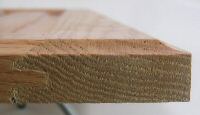
And my response:
End grain is one of those things that can really bite you in the butt if you don’t prep your projects properly. Many times, you finish sanding and everything looks and feels great! But then you apply the finish and all of a sudden your project looks like it was made from two different woods! The end grain soaked up so much finish/stain that it now appears to be a much darker color. Since the end grain is on a different face, where shadows can sometimes play tricks on the eye, you can usually get away with this color discrepancy and few people will ever notice. But there are some areas where this end grain issue is much more obvious and you absolutely must take precautions.
It really all comes down to sanding prep. End grain will always soak up more finish than face grain, and the result will be a darker color. But if you sand it to a higher grit, it tends to burnish the surface and limits the absorption of finish. The result is a lighter color that more closely matches the face grain. So if you plan on sanding the project to 180 grit, I would sand the end grain to 320. That will greatly improve the results.
But here’s the catch: end grain does not sand as easily or as quickly as face grain. So you might be wondering, how do I know when I have sanded enough?? Well, if you recall in our recent Keepsake Box video, I explained my system for sanding end grain. Here’s an excerpt for your convenience:
Comments
22 Responses to “How to Finish End Grain? – Viewer Question”Speak Your Mind and Maybe Win a Prize!
Leave a comment and you could be a winner in our Wood Whisperer Giveaway!And if you want a pic to show with your comment, go get a gravatar!


Yo whats up marc I was working on a book case for the saw dust chronicles 60 build challenge and I had a 2/4 board and it has a step design on the top of it.It was really hard to sand the end grain so do you think its better to hand sand small areas or end grain or try to get a power sander.
Yo what’s up Kosta! For smaller pieces, I would indeed try to sand by hand. It gets really hard to balance a power sander on such a skinny edge. So it will take some elbow grease, but the results will be much better in the end. Also consider ganging a few boards together and you might be able to use the power sander.
Sanding to a higher grit for most instances works realy well, I often use very dark spirit stains on light wood and if the end grain is very absorbant I can sand up to 600-800 grit.
I always do a test piece- once the stain is in grain theres no going back!
If you have a lot of end grain to sand give it a thin coat of shellack first before sanding, it seals the pores and if you get it just right you can get an exact match when you stain, yet again do a test piece (or three) first.
Hey Mark. Thanks for mentioning the sealing idea. I didn’t even think to bring it up in my post.
I heard this tip from Hendrik Varju on Matt’s show. He says to wet just the end grain with mineral spirits before staining. It may take a few coats to get the color to match the rest of the piece but it’s better ‘’sneak up” on it than go too dark and BE stuck. I haven’t used this method myself but thought I’d throw it our there.
Marc,
What do you think of using sanding sealers for the end grain? Or for that matter on the entire piece? Do they help or hurt.
I’m currently building a Cherry End Table and read that cherry can end up with a “blotchy” finish. Would the sanding sealer help ? I’m also considering doing a final coat(or 3) of Arm-R-seal since the table top will be getting daily use/abuse.
Thanks
Joe
Hey Joe. A sanding sealer would accomplish the same thing as the shellac, mentioned above. Personally though, I don’t bother much with sanding sealers. I like to keep shellac on hand at all times, and that serves me just fine for most sealing tasks. And in general, unless I have blotching to worry about, the first coat of ANY finish is the sealer coat. And often, you don’t really need anything other than the finish itself.
Now since you DO have blotching to consider, a sanding sealer would indeed help. Since you are going to use Arm-R-Seal anyway, I would recommend doing a coat of shellac (Bulls Eye Sealcoat is easy to find), let it dry, sand lightly with 320, then start applying your coats of Arm-R-Seal. A great finish for cherry!
Thanks Again Marc!
Shellac and Arm-R-Seal sound like a good plan!
Joe
Yet another reason to NOT use stain.
I think the end problem also seems to vary depending on the type of wood. In my experience, end grain on pine has a stark contrast to the face grain. Perhaps it takes even more sanding than other woods.
I’m with you Germain, unless I ABSOLUTELY have to I always try to let the wood speak for it’s self. But on the rare occasion that I do use stain, I always both sand the wood two or three grits higher and seal it with shellac.
Totally agreed on staining. Not a big fan. But don’t forget that endgrain still gets real dark even with a simple oil-based finish. So even when I am not staining, I will treat my end grain this way. But like Germain says, depends on the wood species.
As I live, I learn. As a new woodworker I appreciated all the comments. It helps me steer my little woodworking ship in the right direction.
All good advice.
A couple of other thoughts…
Whenever possible, I try to avoid exposed end grain. It not only sucks up finish and stain, it also sucks up moisture and humidity–resulting in warping and checking. When feasable, adding strips of wood to the end grain (gluing or tongue and grooving) will hide it and solve the problem. This is not always possible, of course.
Also, a commercial solution to even staining, it you’re doing an “on top of the wood finish” is to put the stain in your finish–i.e. tinted lacquer, varnish, etc. Not elegant, but quick and easy.
DD
One of my sons got a little too happy with the electric sander and burnished the sides of a white oak candle runner I was working on. This is probably a hopelessly basic question, but is there a way to “un-burnish” the sides? Or is that even desirable?
You can certainly go backwards. Just pop in a lower grit and it should bring it back to normal.
In most cases, I try not to sand raw wood too far beyond 180 (end grain being the exception). Wood that gets sanded to a really high grit doesn’t absorb as much finish (as we’ve been discussing). But there is a point where that seems like it would be a bad thing. Part of what makes a good finish durable is soaking into the wood and curing inside the wood fibers. Sanding to an excessively high grit and burnishing the surface takes some of that away and I believe it could result in a weaker finish bond. This is mostly speculation on my part though because I never felt inclined to test it.
Thanks! I appreciate your patience with total noob questions!
What about more sculpted pieces, or sweeping curves that transition slowly from side to end grain… would you just try to “feather in” the difference in sanding or other treatment?
With piece like that I would probably not try to feather in higher grit sanding. As hard as you try you probably won’t be able to sand everything to the appropriate grit. I would sand the whole piece to 180ish and use a sanding sealer before applying a finish. Now, I have not yet made a piece like that, but if/when I do, that’s probably the course I’d take.
Ditto!
makes sense, thanks guys!
I am presently making window valence boxes to conceal room-darkening roller shades. I attach them with a french cleat at the top of the window frame.
How do I attach a picture here of my plan?
Steve
Unfortunately you can’t Steve. But you can post a link to the picture if you have is uploaded somewhere.