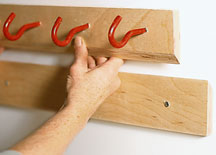
106 – French Cleat Storage System
Download HD .mp4
Download HD .wmv
A French cleat is as ingenious as it is simple. It involves securing a strip of wood with a 45 degree bevel to the wall, and then securing an opposing beveled strip on the back of a cabinet or anything you want to hang. Its incredibly strong and versatile. Its a great way to hang cabinetry and as you’ll see in this video, it can be used to make an awesome modular wall storage unit.

Comments
51 Responses to “106 – French Cleat Storage System”Speak Your Mind and Maybe Win a Prize!
Leave a comment and you could be a winner in our Wood Whisperer Giveaway!And if you want a pic to show with your comment, go get a gravatar!


Very nice. I just added some space to my garge shop by putting bikes and other stuff in the shed. I have a long narrow spot that I would like to add some shelves but we might be moving in the next sixth months so this is perfect because I can take it with! Thanks Marc! What type of Dado blade is that???
That’s the Forrest unit.
The french cleat is a great way to hang almost anything in your shop.
I have a 4′ x 4′ tool board with rows of french cleats. I have two rows of french cleats around three walls in my shop that hold everything from jigs to clamp racks, shelves, speakers, pictures, even a pencil holder made from an old cigar box. I think the wood rack is the only thing attached directly to the walls.
I usually have a few pieces of plywood already cut with a 45 deg angle on one side laying around. It doesn’t take very long to put together a hanger with scrap.
Dave
Another informative mini.
Thanks for covering this topic.
Even though you can find many ways to hang things from a vertical surface, commercial and homebuilt, it doesn’t get much simpler and cheaper than a French cleat.
I use these at work all the time. It is a great way to hang just about anything almost flush against the wall. Never thought to use it as a tool hanging system though. Thanks for the tip!
Looks like someone had a long weekend…must have been the neighborhood clambake, ’tis the time (I looked like that after ours this past weeekend). What is the best and cheapest material for making the cleats? Is it plywood because of the alternating grain pattern or does it really matter?
Doesn’t really matter Dan. Anything will work. But plywood is cheap and stable, so I just default to it every time.
As for my disheveled look, lol, that was actually filmed during the week that I was setting up the new shop. I just held onto the footage for a long time. Yeah, I had a rough week that week, lol.
Dear Mr. Whisperer
This is fantastic. What did you use for the back panel? What did you use for edging? How many, and what type of screws did you use to secure the panel to the wall?
Thanks as always
3/4″ ply for everything. Screws were just regular square drive wood screws. Drywall screws would work just fine. And you can add as many as you like. Mine doesn’t hold anything too heavy so I used about 8 over the whole sheet.
This is a great idea, we have a bunch of templates that we use and this will make it easier to organize them and to add or remove to the system later.
Will have to make this in the next few weeks.
Great mini WW. We use french cleat on all our upper cabinets we ship. Ours are cut at 30 degrees. Don’t know if that makes any difference. We leave a little flat spot on the pointed end 1/16th inch. Makes it easier to pull off when you have a lot of weight.
Thanks again.
I appreciate your site. I’m looking forward to more tech podcasts. Maybe one on setup/maintaining planers/joiners (changing knives).
Like Kris said, I’ve done a few of these with a 30 degree angle which, especially if you only have a circular saw, is a little easier. The only thing about that is that it probably wouldn’t work great for the peg hooks, more for things that pull straight down.
Also, as 3/4 plywood isn’t exactly cheap these days, I think it’s important to mention that you CAN hang your french cleat strips right on drywall. As long as you hit studs and have a good bite, the plywood is perhaps an unnecessary luxury.
If you have larger items or heavier items, like a cabinet, you can even have them land on multiple cleats for extra strength.
-Jer
Good points Jeremy.
I can’t resist: Did the French invent french cleats?
Now I got a project for the weekend! Empty walls, prepare to be cleated!!
yah great technique! I had a old plywood foot locker that I made years ago for the son to take to scout camp. weighs about 30 lbs empty. I put a cleat on the bottom and turned it up with the bottom side against the wall and now it is a huge deep cabinet. I figure it will hold about 100 lbs of stuff. A French cleat was the only way to go.
Another good thing about this system is you can square the cleat to the wall and then when you hang the object [cabinet or whatever]and it will be square to the floor with out having to hold the heavy object up while someone else tells you if it is level.
How the pegs work baffles me. It seems like any movement or extra weight can cause them to fall off. It’s just a 3/4″ triangle, which I would think causes tIhere to be a bit or torque. The higher the peg is, the worse the problem will be. Having a 1/8″ sheet of luan, just long enough to cover the cleat on the front would provide more stability. I guess it’s a matter of how much weight you apply, since the shelves did require a vertical piece like this.
Yeah I wouldn’t use the pegs to do pull-ups or anything. lol But for hanging small tools, rulers, personal protection gear, and stuff along those lines, it works just fine. You are right in that an extra cleat in the front would increase the strength, and this is something that I do for the custom doodads that hold the heavier items. But for smaller items, the simple peg and small cleat work quite well.
I’ve used the french cleat system to hang cabinets on a number of occasions but I’ve never thought of something like this. Good show and great idea.
Today i used your tip to add some storage on my tables saw shelf for my push sticks, feather boards and extra inserts. thanks for the idea.
Marc, how thick (deep) are the strips that you use to span the plywood? Are they 1×2’s or did you just cut some 3/4″ plywood into strips and make the 45 degree rip?
They are just strips cut from a piece of plywood. 3/4″ thick.
I have been checking out your page lately and am very impressed. You have so many great tips. I just moved into a new place and have been working on my garage/shop for the last couple months when i have time. I am going to use this method for sure in one of my corners. I took a before pic and will take some after pics and send when I am complete(hopefully within the week.
Thanks marc u r the man
J
I use them to hold my crullers – they’re very heavy.
Mmmmmmm….. crullers.
a small sweet cake?
I’m in the process of completely re-organizing my basement shop. I have some areas I’ve been trying to figure out
how to utilize better for storage. When I saw this I immediately had a “I coulda had a V8″ moment. I’ve used french cleats for cabinets before but never thought about
using them in this way.
Thanks Marc!!! Your ideas solved a problem I’ve been dealing with for too long. I started on it last night and when it’s done I’ll send pics.
I’ve heard of people using the same concept but for overhead storage and using two cleats on each side (essentially a sliding dovetail joint) but use it as a modular storage system. Thanks for the great videos Marc.
Great mini, Marc. I’ve used the french cleats for hanging my shop cabinets, but never thought of using them as you did. Keep up the good work. I enjoy your site very much.
If I wanted to hang cabinets to a cement basement wall, would this system work? Whould we need a backing, how many screws would you recommend for holding cabinets? I love this concept. We are just starting to put our shop together. I see this being used in the shop, garage and shed. Thank you so much for all you do!!
Hey Terry. The system would actually work just fine on cement walls, even without a backing. That is, assuming you secure the strips to the wall properly. Now I don’t have a lot of masonry experience but I would imagine you could use TapCon style screws every 8-12″ and that should be pretty darn secure. But you might want to get a few more opinions before hanging some nice cabinets based on that advice, lol.
Hey Mark,
At the end of the video you asked us to send you some ideas for holders and such for the cleat system. So here are some of mine.
At the following links you cans see that I have done my entire shop with the cleat system. On the lower cleats I have hung tool supports for my benchtop machines. The Uppers hold cabinets, tool holders and just about anything else.
http://www.superwoodworks.com/.....pShots.htm
http://www.superwoodworks.com/.....olders.htm
I would like to add that you can also buy aluminum Z Clips which are basically the same thing as a french cleat. You can buy them in long lengths and also in small segments. The advantage of the aluminum clips are the narrower depth of 3/8″ and they can also be used in moist areas and outdoors without the worry of mold growth.
I have installed thousands of feet of both and prefer the aluminum clips due to their durability.
I have used this system to hang the cabinets in my shop and it works very well. My current chop is only 18-0 sq/ft but I plane to add on a 252 sq/ft addition next Feb. I will probably use your sheep plywood wi french cleats in the addition.
Thanks
Al
Have been using the “French Cleat” System for years to hang all the cabinets in my shop. The thing I love most is the “extra 3/4″ storage space” you have “behind & between” the cleats on the rear of the cabinets.I store my large carpenter square,hand saws ,even small sheet goods. Anything that is less then 3/4″ thick and will fit between the cleats.
I personally think peg board is better for two reasons.
1) If you use white pegboard then your shop will be brighter.
2) You have more flexibility on where you put things vertically.
It may not have the strength of the french cleat but in most cases it is strong enough for hanging most things on the wall. My shop walls are covered with peg board.
I have used the French cleat for years. I even used it to hang my HDTV to the wall. I added a locking pin so it would not fall or lift off with out the pins removed. The result is a near flush fit to the wall.
this is a great idea. i have already cut my pieces and am ready to start hangin’
Nice little project. I guess I need to add one to my todo list.
For something like a heavy tool cabinet, is a 3/4″ cleat thick enough to handle the load? At what weight should a thicker cleat be considered? Also, for a standard 2×4 wall, is there a concern with adding too much weight? I guess the question there is whether the cleat directs the force down the wall verses away from the wall. Maybe it’s only a concern if you hang a very deep and heavy object.
You might want to consult a structural engineer for answers to these questions Dave. But I can tell you from experience that a heavy tool cabinet hangs quite securely from a 3/4″ baltic birch strip. I suppose there is a limit, though I have no idea what that is.
And I also have no idea about the max load on a couple of studs. But I can’t imagine hanging anything so heavy or deep that it would be an issue (at least in my shop).
I have a 26″ flatscreet TV. I grabbed some bolts that fit the threads where you can install a hanging system. Instead went with a french cleat from some scrap 1″ ply and it worked great, and is very stable. Wouldn’t go much heavier though. Better than using the $120 factory system (what warranty?).
I saw an article in a woodworking magazine by Jock Holmen where he did the same type of wall system. He used 3/4″ plywood with a larger 1/4″ plywood front to make a slot system. I was going to use this in my garage workshop, but then I stumbled across this video. Your system seems alot quicker and easier. Which system do you think would be stronger? Thank you for the great ideas!
Hey John. Hard to say since I don’t completely understand the system you describe by Mr. Holmen. Do you have a picture or something that I can see what the system looks like?
http://americanwoodworker.com/.....-shop.aspx
This is the link that opens the site. Let me know if this doesn’t work.
Thank you,
John
Well, after looking at his design, I would might be a little stronger. But I am only guessing. I don’t think that its so much stronger that it justifies all the extra work though. To me, the beauty of a French Cleat is how easy it is to make. And although the article calls that process “easy”, its no where near as easy as making two cuts on one piece of ply and being done.
Thanks! That’s about what I was thinking. Thanks for the great ideas and awesome website
I have used the french cleat to hang cabinets, headboards, framed art, etc. I think your modular wall unit is the best use yet.
Robert
Amazing…so simple. I have been working in shops for 20 years and hadn’t seen this. Called my Dad and asked why he hadn’t shown me. He didn’t know about them. Amazing, I finally get to show him something. He’s coming to visit and I think we’ll line my garage with them and cut enough while he’s here to line his. Thanks, hopefuly, I can do a before and after.
I am in the process of re-organizing my garage/workshop. This is going to save me lots of time and money. Thanks for the great tip.
Mike