124 – Cutting Board Disaster


Right Click to Download
Right Click to Download in HD

The Discovery:

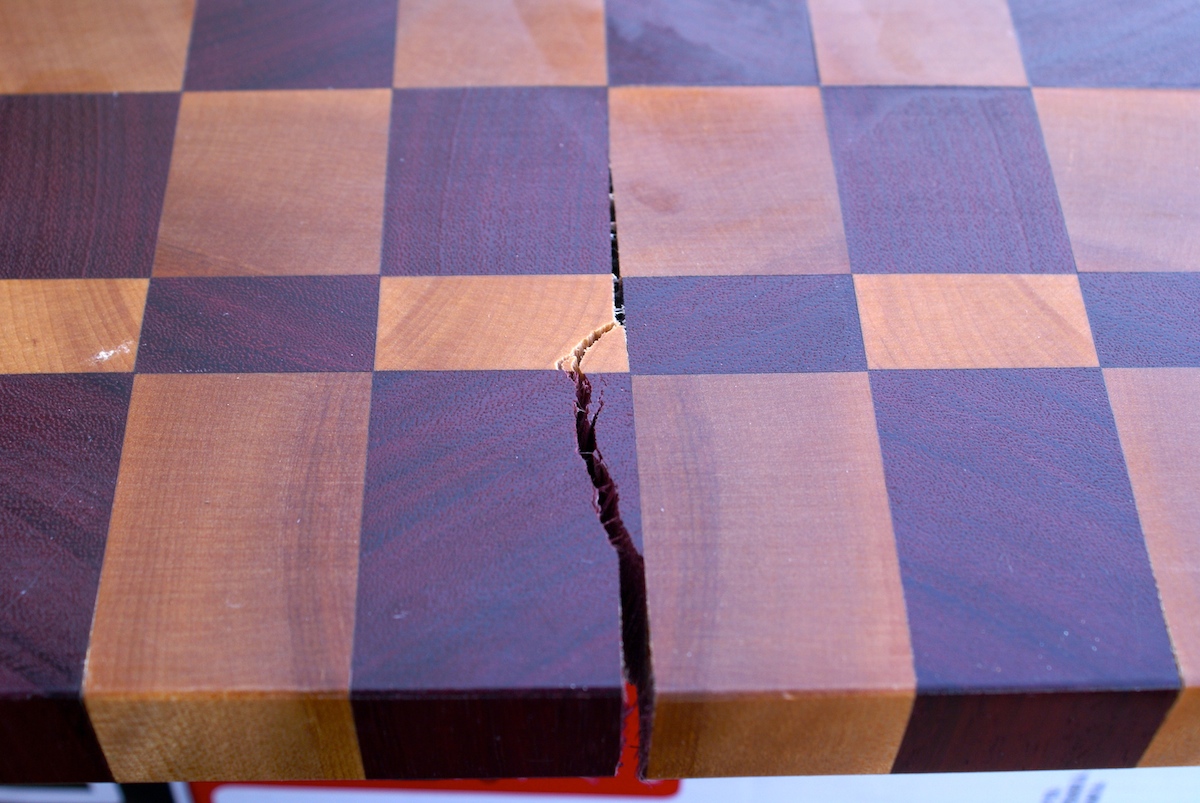
A few months ago, I woke up one morning, poured my coffee, and was incredibly disappointed to see that my cutting board exploded! OK so maybe it wasn’t all that violent but it was cupped like crazy and had a very large split. Upon further inspection, I noticed a bit of trapped water in the center of the underside of the board. Now the thing to remember about end grain cutting boards is that even after finishing, they will still soak up moisture like a sponge. So standing water is your cutting board’s Kryptonite!

What Happened?

So how does the split actually occur? Well let’s think about what happened. The water soaked into the center of the board and as a result, the center “squares” swelled and expanded. Because the moisture was in the center only, the wood in the outer perimeter did not expand. So something had to give. The resulting crack is really nothing more than pressure relief. Think of it like surrounding a piece of solid wood in a frame. Eventually, the joints in the outer frame will open up if the board in the middle expands.

The Epoxy Fix:

The first step in repairing this disaster simply involves waiting. After a few weeks, the board flattened out and the crack closed up almost completely. But the gap was still big enough that I wanted to use a gap-filling glue, so epoxy did the trick. Now I know what you are thinking. Is epoxy food-safe? While I have heard that food grade FDA-approved epoxies do exist, I have never seen them. And I can definitely say that the West System Epoxy I use is not FDA-approved. So why would I use this on my cutting board? Generally speaking, its the same logic I subscribe to when discussing the safety of film finishes. That is, once cured, the product is inert. In other words, its not chemically reactive and its not actively leaching chemicals under normal room temperature conditions. Furthermore, the crack represents such a small area that actual food contact would be absolutely minimal. Now while I am not prepared to tell you epoxy is completely food-safe, I will say that I consider cured epoxy safe enough to use on a small crack on MY cutting board. Ultimately, the final decision is yours.

Want to make an end-grain cutting board like this? Check this out!


77 Responses to “124 – Cutting Board Disaster”

  1. Dan Drabek says:

    While I understand your thinking, in my experience, cracking occurs due to the wood drying out, rather than from expansion of surrounding areas –which tends to create buckling and warping rather than cracking. I would suspect the combination of the tropical hardwoods transplanted to your dry Arizona air is what caused the cracking. The edges of the cutting board are more exposed to the air than the center of the board. And the wet spot in the center probably helped protect that area from shrinkage as well. My guess is that the crack would have occurred regardless of the board getting wet, though the lack of shrinkage in the middle gave the edges something to work against. Giving the wood a good soaking with food-grade mineral oil (like baby oil) can help reduce the humidity shifts by displacing the water with oil, as well as slowing down the evaporation process.
    I do agree about the inert character of the cured epoxy. Epoxy is so waterproof that not even water vapor can pass into or through it –let alone liquid water. So any significant leaching of chemicals into food would probably be very unlikely. Epoxy resin has been used to coat the insides of large commercial aquariums for decades with no ill effects to the fish –who tend to be very chemical-sensitive. Another plus is that cured epoxy is slightly resilient, so it can give and take a bit when humidity changes make the wood move. It can also be colored with wood dust or other dry pigment to help blend in with the wood.

    DD

    • thewoodwhisperer says:

      Hey Dan. This particular board has lived in my Arizona kitchen for over 5 years so its about as dry and stable as a cutting board can possibly get. Given the evidence I was presented with, there is no doubt in my mind that the crack was caused by the absorption of water and subsequent expansion of the center of the board. And of course if the cutting board expands dramatically in the center but not around the perimeter, something is going to give. This is also further supported by the fact that the board returned to normal once the moisture left.

      And I am glad I am not alone in my comfort using epoxy. Love that stuff!

      • Dan Drabek says:

        Can’t argue with that.

        The oil should help in either case.

        DD

      • Josh Wilson says:

        Am very VERY new to the world of wood working, but I have been in the flooring business for a while now. Most times when a wood cups it makes a “u” shape with the bottom of the “u” toward the moisture, so I would most cetainly say it was the water. Love your site and what you do, it’s what really has gotten me interested in wood working, Thanks! and keep up the great work.

  2. I haven’t made a cutting board as yet but, I suppose putting little rubber feet on the bottom side (Why would you put them anywhere else?) would help to reduce the chance of this happening.

    Thanks for the heads-up.

  3. Doug says:

    Pretty cool Marc.
    Is the West marine 205 hardener fast or slow…..is that what you typically use for epoxy?

    • thewoodwhisperer says:

      Hey Doug. 205 is the fast hardener. I actually own both the 205 and 206 stuff. Just depends on the job. Even the fast hardener is a little slower than most 5-minute varieties I have used. It is also less viscous.

  4. Bryan H says:

    Amazing the almost lifelike qualities of the wood…and to think of how many people would have thrown it away without another thought! Nice work on the fix, the board looks fantastic and no doubt you will get plenty of use out of it for years to come.

  5. Mark B. says:

    While West System and MAS epoxies mostly set up within 24 hours, it can take weeks (and even months if the environment is cold) before they completely cure.
    Also, people that work frequently with epoxy sometimes develop allergies to it. The dust it produces when sanded (especially if not completely cured, say < 2 weeks) can cause lung and skin reactions. Personally, I'm not sure I would use epoxy on anything that comes in contact with food as I would worry about prolonged exposure through the food you prepare on it. At the very least, I would wait a few weeks before returning this cutting board to work in the kitchen. Thanks for sharing this mishap – I would not have expected the cutting board to have cracked from water so quickly.

    Best,
    Mark B.

    • Dan Drabek says:

      Actually, the dermatitis allergies with epoxy are due to continued exposure to the uncured resin. (Lots of boat builders develop this allergy and sensitivity gets worse with continued exposure.
      Check the following link–especially the first paragraph.
      http://dermnetnz.org/dermatitis/epoxy-allergy.html
      Breathing sanding dust is bad for you whether inert or not, of course.

      DD

  6. Dave says:

    Marc, nice save. Any concern with the epoxy and the fact that the wood was already finished all the way through?

    • thewoodwhisperer says:

      Not really. There is still a lot of “raw” wood inside the cracked area and even if it was loaded with finish, epoxy would probably still have a really tight grip.

  7. Brett says:

    Well you truely have earned your “WoodWhisperer” name with a recovery like that! That is a great lesson learned for all of us. Thanks for sharing your experience with us, now I know to keep my cutting boards dry.

    I made some cutting boards up for Christmas a handful of years ago and one of them was sent to Florida where it is a lot warmer and humid than in Washington. HMmmmm… maybe I should call and see if its still holding up, or if it has already been turned into firewood! ;)

  8. Jay says:

    Clever idea using vacuum to pull the epoxy into and through the crack. I wou
    D have tried to squeegee it from both sides and not got en full penetration. I will have to put in my notes. I have made very thin cutting boards (pizza paddle thin) and if I don’t stand them on end to dry they will cup, until I turn them over to let the backside dry.

  9. Gerald Jensen says:

    Nice save … would never have thought of using the ShopVac to draw the epoxy into the breach. Way to go … and Thanks!

  10. Stephen says:

    Thanks for posting the failure. Too many wood workers only post their successes, which doesn’t appear to be how any of my projects ever work out. :-) It’s really helpful to see the failures and how you recover from them.

    -Stephen

  11. rory says:

    hey so what i find is good for small cracks is a syringe with a large gauge needle like 19 gauge worked, tho with an epoxy maybe something larger, whatever lets it through
    and just pull the plunger out and fill the tube

    cheers
    rory d.
    australia

    • thewoodwhisperer says:

      Oh awesome idea! But I do think most needles would indeed have trouble pushing and pulling epoxy. I actually use those curved plastic dental syringes. Even those have trouble pushing the epoxy through but they get the job done. Added bonus is you can’t stick yourself with them. :)

  12. Will Stokes says:

    Yikes, that was almost painful to watch! Thanks for the lesson though. I always store my cutting boards on their side to try to avoid this type of thing from occurring. I was always just worried about cupping, not outright explosion! Glad to see you did such a nice job saving it. The shop vac epoxy trip is pretty neat.

  13. Frank Kovach says:

    I’m really glad you posted this. I just mailed one from NC to GA, I have two living in OH and one living in FL. I remember discussing with you via email elevating them somehow, but doing it in such a way that looked good and kept with the style of the board. Unfortunately, I haven’t developed something yet, but the ideas that keep running through my mind when I give it some thought are to drill stopped holes in the corners and insert metal rods. Metal because wood would (ha!) not work well if it got wet on the counter, and plastic or rubber would detract from the appearance (in my opinion). Of course, maybe if you could find some rubber or plastic feet that looked right…..but I don’t think so. Now that I’m thinking about it again, if you drill holes you have some problems with finishing, but, if it’s elevated you have probably balanced the scales in your favor between not applying a perfect finish and keeping moisture away from direct contact. Anybody else have any ideas? Besides using adhesive backed rubber feet?

    • Jeff Wenzel says:

      I give out a kitchen shelf liner (that look like router non-slip pads) with the board. You can find a large selection of colors from Bed Bath & Beyond and Lowe’s. This mat provides friction so the board doesn’t slip when cutting (I make 2 sided boards, so feet are not preferred) and it raises the board off of the counter.

      http://www.amazon.com/Grip-She.....B000KFSOFI

    • David Roberts says:

      I used the little rubber adhesive-backed clear cabinet bumpers, but with a twist. After finishing the board, I drilled shallow holes with a forstner bit. Then I rubbed the adhesive off the rubber (it’s not very strong) and stuck them in the holes with super glue. That way, it’s not so high up and it’s barely even noticeable. So far the glue has held up just fine, as well.

  14. Mark says:

    This was another great video. I only wish you had made it a number of years ago. I apparently threw out a perfectly fine cutting board. Well, now I know for the future. Thanks Marc!

  15. Martin King says:

    Marc,

    I built your board as designed and within 2 weeks of
    sitting on a damp counter, it cracked like yours. After
    doing the repair, I installed rubber feet at the corners
    and never had the problem again. Having the bottom
    elevated enough to permit air circulation has made
    all the difference.

    Martin

  16. joseph stanley says:

    I found your site looking for a how to on making a end grain cutting board, and now i am hooked on podcast thank u for that. good to know how to fix it if i ever find a place to get the hard woods to make it in the first place i cannot get them anywhere around here

    thank you

  17. Trevor says:

    Marc Thanks for sharing that one I have in the past used a syringe for introducing glue into difficult areas, but that tip with the shopvac is priceless man I’m 58 & worked with wood for a lot of years even before I made it my job & I’ve never seen that done before you’re a star.In fact I think you are so good at this woodwork stuff you should try it for a living
    Best to you both
    Trevor

  18. Eric Blad says:

    Hey Marc: I gasped when I saw that crack. I am also glad you didnt throw it away since it is a beautiful piece. The making of that cutting board several years ago was the first WoodWhisperer video I ever watched.

  19. nick says:

    Sounds like a great solution Marc. I think the epoxy is a good solution to a piece that will be wet so often. I can’t wait to make an end grain cutting board for myself!

    Nice work!
    NWB

  20. Paul Ray says:

    I have to ask the question. How were you storing the cutting board? Since it is generally recommend that cutting boards be stored to dry on end. I have had one cutting board do the same thing (store bought) when it was not sufficiently oiled. I also have to thank you for all the great videos. I made a 22×24 kitchen island with the techniques I learned from the cutting board and mortise and tenon videos.
    Thanks

    • thewoodwhisperer says:

      How I store it is flat. How I let it dry is on end. This incident was actually due to washing dishes. I keep the board right next to the sink (makes the most sense in our kitchen). And apparently while washing dishes, a little water got trapped under the board.

  21. dylder says:

    Ya learn something new everyday… I like the vacumn trick and can see where that one is going to come in handy.

    Thanks
    dw

  22. Dan Drabek says:

    I suppose that one solution would be to construct the board using side grain rather than end grain. It might be more prone to scratches from the knife, but would be much less absorbent. I always used to think that the bindings on a guitar were purely decorative. In fact, they were utilized to cover the end grain of the top and back to help prevent warping.

    DD

  23. Dave Clark says:

    That vacuum trick is sweet! Thanks for sharing! :-)

  24. nateswoodworks says:

    Wow, it is always amazing how the water can sneak in and ruin the day, great post!!

  25. Derek Hall says:

    Thanks for showing us this — and how cool that you were able to fix it after what looked to be life ending (as far as cutting boards go).

  26. Perfect timing on that video! I had a similar experience about a week ago with a giant cutting board I made last summer and I’ve been contemplating how I was going to repair it. In the summer I make a lot of spaghetti sauce from tomatoes from my garden so it’s important to have the cutting board and my knives ready for tons of coring and slicing. This’ll be the perfect fix before I start processing tomatoes!

  27. DC says:

    Im surprised the sealers/finishers would still allow some water to soak in? i always thought the more the wood was treated, the more water resistant it increasingly became. guess i shouldnt be so cavalier with my own cutting board!

    • thewoodwhisperer says:

      Yeah it seems there is really no such thing as “water proof”, when it comes to a cutting board. The finish will slow down the process, but it won’t stop it completely. The water was trapped under there for at least a couple days. So that much direct contact was just more than the board could handle.

      • Dan Drabek says:

        You could try giving the entire bottom side of the cutting board a coat of thinned epoxy. (you can thin it with acetone) That would make it waterproof. Or another possibility (just cogitating) would be to laminate a thin layer of slab-sawn wood to the bottom side.

        DD

  28. Jim Jones says:

    Frank Kovach and others have mentioned rubber feet or something else to allow the bottom to air dry.

    Here is an idea from a cutting board we had for many years. It had feet made of — wood. Same wood as the board. They were sturdy and we never had a problem with them over many years and they looked very nice.

    Never measured them (don’t have it now) so I’m guessing that the feet were about 1 3/4″ in diameter at the bottom, maybe 1 3/8″ at the top, and maybe 5/8″ thick. Rounded bottom edge. Not sure how they were attached. May have been glued and screwed with a blind double ended wood screw.

    Maybe someone will try it and show the results.

  29. Rick W says:

    I am glad I made all off mine this X-mas with the rubber feet. They also help the board from rocking if you do get a little bow in the board.

  30. Will says:

    As far as the inert nature of the epoxy goes, I would think you’ve only got half of the story. Yes, it is inert in the kitchen and most likely with the foods you cut on it but as you use the board, you are cutting into into it, into the crack and the epoxy. Over time and cuts, you are bound to incorporate very small pieces of epoxy into your food. I don’t really know the toxicity of the epoxy and pretty much everything around us these days is carcinogenic, but it is worth considering.

  31. medfloat says:

    Marc, you just solidified why I return to your website time and time again. Your creation defected on you and in your unintentional experimental thoughts you found an easy fix. The vacuum assistance, your patience and explanation of your process was refreshing. Keep up your outstanding work.

  32. Shane says:

    I had a similar problem: I made a small end grain ring box and pulled a typical rookie move when I wiped off the box with a wet rag after the first time I sanded it. The box was straight and square before wiping and in ten minutes it buckled so much that the top and bottom halves both turned into bow shapes and a small knot on the inside popped out. Really, just a quick wipe, not much water at all. When I saw it, I let the pieces dry in 170 degree oven for ten minutes and then stuck them under my small 20 lb anvil for a night and they were both straight again by morning, but I though for sure I had ruined my piece.

  33. Ben H says:

    That shop vac trick the bees knees man.

  34. medfloat says:

    Another reason you have one of the best websites…Your cutting board broke so instead of hiding the issue you brought it forward and explaind the how and why of the damage and repair. What could have remained an unknown to all of your whisperites turned into a teaching moment. Much kudos to you…Hey Nichole make sure he wipes off the counter after he does the dishes next time!!

    • Frank Kovach says:

      Medfloat, what’s up with your name? You ever done one?

      • medfloat says:

        yes I have, 2 in fact. Was with 24 MEU in the 90′s. Glad you picked up on the name, I have been using it for years and your the first to ask the meaning.

    • Jim Jones says:

      Also shows Marc uses what he builds. Doesn’t just toss it to the side to move on to the next “demo” project.

  35. BigguyZ says:

    I think it’s interesting that the crack occured at the glue joint. I always heard that the joint is stronger than the wood once cured, so I would have expected more of the crack to be in the middle of the section.

    Either way, very interesting! I LOVE the trick with the shop vac. I’ll steal that myself sometime…

    • thewoodwhisperer says:

      Well you can’t see it in the video, but the crack was actually just adjacent to the glue joint. The inside of the crack had torn fresh fibers exposed, but for the most part, the glue line was intact. And you can see after the first inch or so, the crack goes pretty wacky, then returns to the joint area. Now the crack did seem to be following the joint at the back. So I think in this case we can say the joint was at least as strong as the wood itself? :)

  36. Gary says:

    Thanks for showing us your repairs. I put rubber feet on the bottom of my cutting board when I first made it. I did it to keep it from sliding around on the counter while using it. After cleaning the board I always towel dry it and then let it stand on a side to further dry.

  37. shane hibberts says:

    Hey marc great help with this video as a fleamarketer cutting boards and solid wood items are one of the things i look for to buy, fix, and resale. I cant tell you how many items ive turned away from because the fix looked to time consuming to repair. Now I have a new way of fixing some unsightly cracks.

  38. Benjamin Roesler says:

    This crack makes sense, just think back to the old ax yard, chopping firewood. Wood likes to split along the grain at the ends of logs, and boards as well. You’ve taken two boards, with four ends total, 15 inches between them, to 64 boards with an inch and a half between them.

  39. Stacey B says:

    That was a great tip. Loved how you use the vaccum to get the epoxy pulled through the crack.

  40. Justin says:

    Great video as always. I definetly hope this doesn’t happen to me! Least I know how to fix it if it does. Thanks!

  41. Jordan Simpson says:

    I love the vacuum Idea, But as for the card scraper on the epoxy, that gives me flashbacks of scraping off big panels to clean up epoxy inlay work! But it certainly does the best job

  42. MitchF says:

    The purpose of end grain cutting boards is to keep the knife sharp. Has anyone considered whether the epoxy would dull the knives?

  43. Everett says:

    This happened to my board. I had it in the car on a hot day this past weekend, and my wife pointed it out. I believe the spot had a “line” in the wood grain in that exact area it cracked though…

    I built my board with Poly glue (Gorilla glue) so I did Marc’s vacuum technique with that instead, and it seemed to worked great.

  44. Dean Hancock says:

    Tried the cutting board project using Maple and Sapele. Made four of them, one for me and three as gifts. They are beautiful. I used the rubber feet to keep them out of the liquid and was generous with the baby oil. After two weeks of use I noticed that when washed the baby oil would weep to the surface, especially after washing (by hand). Next I noticed significant warpage. I’m guessing that is because the end grain cut exposes more fibers to air and liquid. Shall I seal the board? If so, is there something to use other than epoxy?

    • Hey Dean. First, I just want to make sure that you are using pure mineral oil. I know some baby oils can have lots of other ingredients that might not be good for a food surface.

      As to the problems you experienced, that’s one of the reasons why I don’t personally use a pure mineral oil finish. Mineral oil never really cures. It soaks into the fibers and eventually wears off the surface. So it needs to be reapplied. But since end grain is like a series of straws, that oil gets sucked in and can seep out over time.

      Now I wouldn’t recommend sealing the board with epoxy because we don’t really want a film on the surface. And at this point, varnish is going to be difficult to apply using my recommend method simply because you have the wood soaked with a non-curing oil. So I would probably recommend one of two things. First would be to use a mineral oil/wax mixture on the surface. The wax component will help lock in the mineral oil to some extent and give you a more water-resistant surface. The second option would be to simply use the board as is. Over time, the mineral oil will stop seeping out and the board will become “dry”. At this point, you can give the board a light sanding and then try the varnishing method I outline in my cutting board video. Hope that helps.

  45. Brad J says:

    Marc, thanks for all the amazing posts and ideas on your site! I am one of the thousands of people who have started making cutting boards because of your tutorial.

    One quick question for you, I am making a cutting board where some of the maple wood grain has small voids. I forget the term for this condition is but it was in the heartwood. I was not aware of the grain condition until after I cut up the face grain lamination or I would have not used it for a cutting board. Any suggestions on how to fill these voids? My first thought was to fill them with melted bees wax but then I came across this post and wondered if I should be using epoxy resin instead.

    Thanks again, I appreciate any suggestions you may have!

  46. Chris says:

    Another awesome video! So here’s me delema. I have a board I’ve been working on and I’m just about to the point of varnishing it with Marc’s method (like I’ve done with all my other boards) but I noticed some of the seams between boards have some very small gaps (maybe 1/64″). Should I epoxy them before the varnish or should I varnish first then epoxy then followed by sanding and another varnish coat? Could you use a shellac stick and drip into the gaps then sand excess off?

    Chris

    • Hey Chris. This is always a tricky thing to answer simply because of the food safety aspect. The only product that I think would do the job properly is epoxy. Small gaps can easily turn into large gaps, especially on a cutting board. So epoxy does a fine job of filling the gap and holding it together. The issue is the question of epoxy food safeness. Much like finishes, most things I read indicate that its safe for light food contact. And in this case, it would indeed be very light. But its still something to think about. If it were my board, I would probably fill with epoxy. But to answer your question, I would seal with a coat or two of the varnish mix first, then the epoxy, then sand, then finish up with the varnish again. The reason is because the epoxy will stain any wood it comes into contact with. Having the surface pre-sealed to some extent should help prevent that.

  47. Dave Smith says:

    Made several of these at Christmas time….banded most of them in either walnut or cherry. MOST of them cracked even before use! They were no where near any H2O…just sitting in the shop or in the house prior to gifting. Could it be that I banded them too soon after glueing up the blocks? Should I have left the glue cure for days/weeks before trying to band? I love these, but they are way too much work to have blow up!

    • Hey Dave. Unfortunately, if I understand you correctly, the banding itself is a problem. In general, you never want to surround a solid piece of wood with a frame of any sort. A board like this needs to expand in all directions and if you wrap it with some sort of banding, it will indeed explode at some point or another. If you can, I would cut off the banding and see if you can repair the boards. I don’t know if they are salvageable but it might be worth a shot.

Leave a Reply


Stay Connected

Search

Coming Up

Get Woodworking Week

2012,02,05,0,0,0

Video: Installing a Knob

2012,02,06,0,0,0

Box Week

2012,02,13,0,0,0

Video: Tapping Threads

2012,02,22,0,0,0


The Guild

What is the Guild?

The Wood Whisperer Guild is a unique and interactive online woodworking school. We invite you to join   our premium membership and build 2 projects over the course of a year with Marc and your fellow guild members.

Visit the guild page
for full details.

What's New

Coming Up

Video 7

2012,02,10,0,0,0


Woodtalk Online


    Support our Advertisers


    Local Market


    The Guild

    An interactive online woodworking school. Learn how to build furniture at your pace with the aid of incredibly detailed videos. Members recieve numerous other benefits including discounts and access to special live events.

    WoodTalk Online

    Connect with your fellow woodworkers in a friendly environment. Learn something new or simply share your knowledge. Design, Share, Build.

    Stores

    Support us by shopping in our store. DVD’s, t-shirts, hats, coffee mugs, project plans, and more!

    Behind the Scenes

    Education and Entertainment for the modern woodworker.

    Contact

    Education and Entertainment for the modern woodworker.


    (n) Copyright © 2010 The Wood Whisperer. All rights reserved.
    Designed and Developed by Underscorefunk Design